
Improving OEE is not an analytics project. You raise the number by finding the minutes you are losing, agreeing with maintenance on why you lost them, and making sure the fix happens before the next shift starts. Most plants can find three to five points in the first quarter without buying a single new machine. See what those minutes are worth on your line in the ROI Report.
Start with the minutes, not the score
A plant sitting at 62% is not one problem. It is a changeover running eleven minutes past standard, a ninety-second micro-stop nobody logs, a slow cycle on the number-two filler, and a scrap spike on third shift.
Until the loss is split by asset, shift and product, every improvement plan is a guess. Take the signal off the controller rather than off a clipboard. The stops operators do not log are usually the ones costing the most, because a ninety-second stop feels like nothing to the person standing there and adds up to hours across a month.
Three questions tell you whether you are ready to improve the number:
- Can you see losses by asset, by shift and by product, without someone building the view by hand?
- Do the short stops appear at all, or only the ones long enough for someone to write down?
- Does yesterday's loss data exist before the morning meeting starts?
If any answer is no, fix the measurement before you fix the machine. Our OEE software buyer guide covers what to look for if you are evaluating tools to do that.
Agree the reason codes before you chase anything
OEE is a negotiation between operations, maintenance and quality. If the loss tree ships fixed from a vendor and nobody on site can edit it, maintenance disputes the numbers inside a month and the program dies quietly.
Sit the three teams down, write the loss categories in their words, and give the line a quick-tap entry that takes under five seconds. A reason code an operator has to hunt for is a reason code that gets left blank, and a blank reason code is a loss you will chase again next quarter.
Fix the follow-through, not the chart
The gap between knowing and doing is where OEE stalls. Most plants already know roughly where their losses are. What they do not have is a reliable path from the loss to the work.
- When availability drops, the work order should open in maintenance on its own.
- When performance drifts past a threshold, the supervisor should already know, not find out at handover.
- When the morning meeting starts, the last 24 hours of losses should be on the screen without a process engineer building it at 5 a.m.
Repeat faults are the fastest win here. Fix Finder reads corrective-action history across every connected plant and routes the proven fix to the operator standing at the line, so nobody re-diagnoses a problem another site closed eight months ago. That is shorter repair time, not prediction.
Make the meeting produce owned actions
Tier meetings raise OEE only when they leave behind an owner, a date and a check.
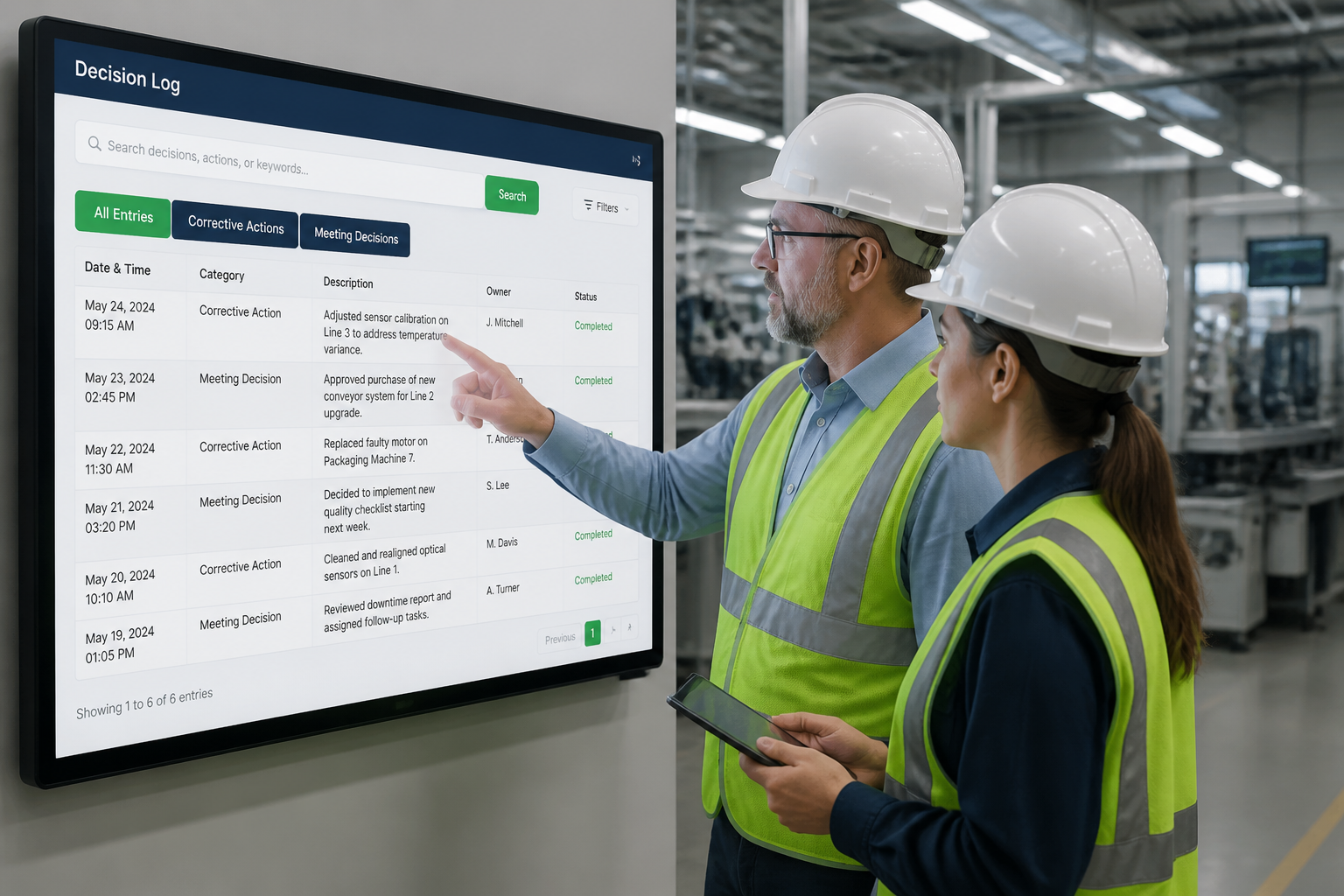
Meeting Sense captures what was agreed and turns it into tracked actions. Meeting Insight shows which of last month's actions actually moved the number. Discussion without a tracked action is a standing meeting about the same 62%.
Verify the fix held
This is the step most plants skip. Compare the loss category before and after, on the same asset and the same product, over a comparable run length. If it did not move, the fix was wrong, and the plant needs to know this week rather than at the quarterly review.
Verification is also what makes the next improvement cheaper. Once a plant can prove which fixes worked, it stops re-arguing the same maintenance decisions every quarter.
What good looks like after a quarter
Schneider Electric runs this model across more than 200 plants and reports a 4 to 5% improvement in plant performance. Abafoods moved corrective actions from days to hours with 150+ shop-floor users.
Neither result came from a better chart. Both came from shortening the distance between a loss appearing and someone owning it.
Where Decisyon fits
Smart Gateway connects to the controllers, usually inside a day, so the loss data is machine-sourced rather than hand-entered. LOOP carries each loss into an owned action, escalates it when it stalls, checks it against the number afterwards, and makes the fix findable at the next plant.
That is the chain that moves OEE: factory data to intelligence, intelligence to a decision, the decision to execution, and execution back into what the plant knows. Estimate your number in the ROI Report.