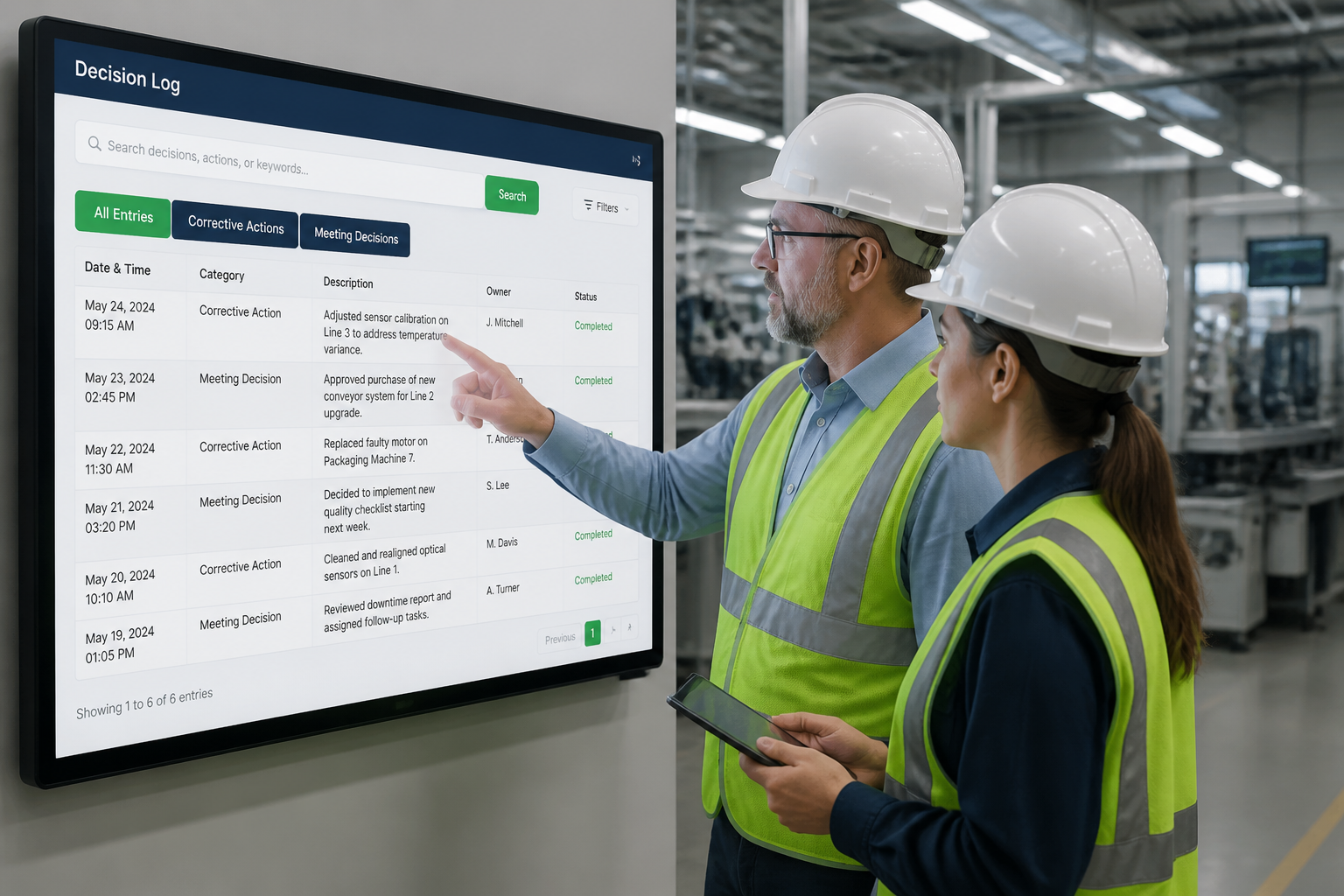
Manufacturing knowledge management is the discipline of turning what your plants have already decided, tried, and fixed into an asset the next shift can search in seconds. The plants doing it well are not building bigger SharePoints — they are capturing meeting decisions, corrective actions, and shift outcomes at the source, then making every one of them queryable by any leader on any site. The lift shows up in onboarding time, recurring-issue resolution, and the quarterly review that finally cites what was actually said. See what searchable decision history is worth on your line in the ROI Report.
Every plant is a knowledge factory that leaks. Tier meetings decide something. A shift leader closes a corrective action. An engineer solves a stubborn CIP overrun at 2 a.m. Six months later the same fault repeats on a sister line, a new plant manager onboards blind, and the quarterly review reconstructs the year from memory. The knowledge existed. The system to find it did not.
What manufacturing knowledge management actually is
Not a document repository. Not a wiki nobody edits. It is the operational layer that captures decisions, actions, root causes, and outcomes as they happen — in the tier meeting, in the corrective action, in the shift handoff — and makes them retrievable in the flow of the next decision.
Three inputs matter:
- Meeting records — every tier, SIM, SQDIP, and operational huddle, with actions, owners, and outcomes attached.
- Incident and corrective-action history — what broke, what was tried, what worked.
- Shift and production context — the SKU, the line, the operator, the settings at the time.
The knowledge management part is not filing them. It is making all three searchable together, in plain language, from any device on the floor or in the office.
Why manufacturing knowledge decays faster than any other industry's
Four structural reasons — every plant leader has felt each of them.
1. Shift turnover breaks the audit trail
Three shifts, seven-day operations, planned rotations, and an aging workforce. Every 24 hours a decision loop closes without the person who opened it in the room. If the record is a whiteboard photo or a supervisor's memory, it is already lost.
2. Multi-plant scale makes local wins invisible
A packaging line in Italy solves the same changeover defect that hits a US line six months later. Nobody knows. There is no query that spans the two plants because the two plants file their meeting notes in different folders.
3. Regulated environments punish weak trace
In pharma and food and beverage, every deviation and every batch decision has to be defensible. Reconstructing "why did we run that setpoint on that day" from a stack of PDFs and a departed engineer's inbox is the audit finding waiting to happen.
4. The knowledge lives in meetings, not documents
Most operational knowledge is transacted verbally in a 15-minute huddle and written down in shorthand. A shared drive indexes the document that summarized it a week later, not the decision at the moment it was made. The system of record is the wrong system.
What changes when the system is right
The bar is low: any leader, any plant, a plain-language question, an answer in seconds with the meeting date and the owner attached. That capability changes four things.
- Onboarding. A new plant manager can ask "what have we tried on Line 3 changeover in the last 18 months?" and read the actual history. Months of ride-along context in an afternoon.
- Recurring issues. When the same fault code hits a sister line, the operator finds the fix that worked last time — attributed, dated, and repeatable.
- Quarterly reviews. The review is grounded in what was decided, not what was remembered. The escalation pattern is visible. The commitments that slipped are countable.
- Corrective actions and audits. Every deviation ties to the meeting where it was raised, the action assigned, and the closure that followed. The trace is a byproduct of running the plant, not a separate exercise.
How the options compare
| Capability | Shared drive | Meeting-note tool | Manufacturing knowledge management system |
|---|---|---|---|
| Captures meeting decisions at the source | No | Partial | Yes |
| Links decision to action to outcome | Manual | No | Yes |
| Cross-plant, cross-shift search | Limited | No | Yes |
| Plain-language queries with citations | No | Partial | Yes |
| Regulated-environment audit trail | Manual reconstruction | No | Native |
| Available on shop-floor tablets | No | Partial | Yes |
Most plants sit in the first two columns and pay for it in every new-hire ramp and every repeated defect.
What the numbers look like on real plants
Schneider Electric deployed LOOP across 218 Schneider plants globally. Every day, 100% of employees in scope use it — 4,000+ concurrent users per shift — and the shared operational picture drives a 4–5% lift in plant performance. Anthony Loy on the site team: "It is at the center of our daily performance meetings and enabled us to improve our site performance by 4–5%." The lift comes from the same rhythm being visible everywhere, with every decision searchable across the network. Read the full breakdown.
Abafoods put 150 shop-floor users on one collaborative platform. The result: fewer internal non-conformities, higher conformance to plan, and manufacturing, quality, and planning finally sharing the same live picture of the plant. Luca Europeo's phrasing: "Corrective actions reach the line in hours, not days." That is knowledge management working, measured in hours saved on every corrective loop. Read the full breakdown.
Estimate your plant's number the same way Schneider and Abafoods did — run the ROI Report.
What to ignore
Vendor demos that lead with the transcription. Transcription is table stakes. The value is the query across five years of decisions, not the accuracy of one meeting's notes. Ignore any pitch that cannot show a search returning a specific decision with the meeting date, the owner, and the outcome linked.
Three questions to ask instead:
- Can I search decisions across every plant, in one query, without picking a folder first?
- Does every action tie back to the meeting it came from and the outcome it produced?
- What does the audit trail look like when a regulator asks for the history of one deviation?
Where Decisyon fits
Decisyon's Meeting Insight agent reads every past discussion, decision, action and outcome across the enterprise and returns the specific call, with its date and owner, to the leader who asked. Meeting Sense captures those decisions in the huddle in the first place, so the record builds itself. Both sit inside the same LOOP workspace already running the daily rhythm — no separate tool, no second place to search.
Two ways to size it on your operation:
- Run the ROI Report — two minutes, uses your own shift and plant numbers.
- Read the case studies — Schneider and Abafoods, both real deployments.