MES (manufacturing execution system) records what the plant produced: orders, materials, genealogy, machine states and quality checks. It doesn't run the daily work around those records: the tier meeting, the escalation when a problem stalls, the follow-up on who owns which action, the handover between shifts, or sharing a proven fix with another plant. LOOP (Lean Operations Optimizer) covers that daily layer and sits next to the MES you already have. See what the gap costs your plant in the ROI Report.
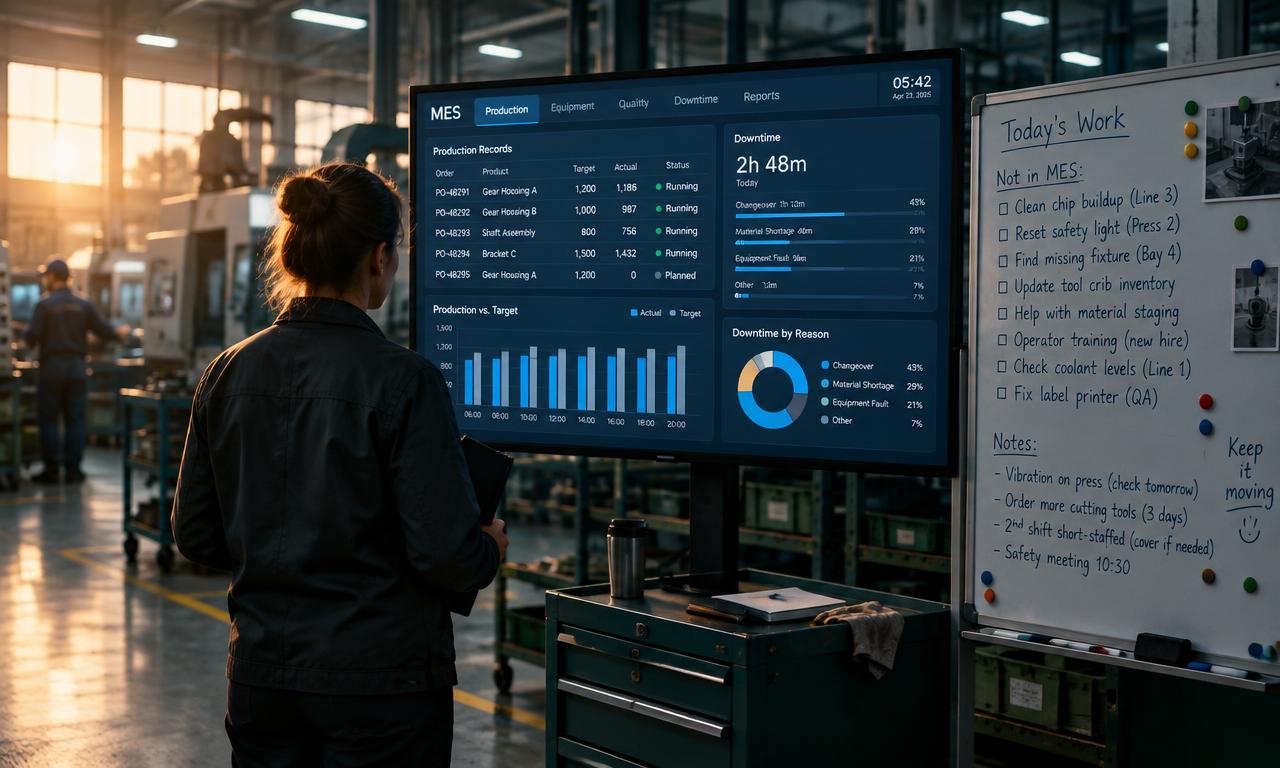
It is 6:45 a.m. The MES screen says Line 2 lost 52 minutes overnight to a filler jam. That number is accurate. What the MES can't tell the day supervisor is whether anyone owns the jam, whether it happened last week too, or what maintenance tried at 3 a.m. That lives in a whiteboard photo, a text message and the night lead's memory.
The MES did its job. The day still starts blind.
What MES is built to do
An MES is the system of record for production. Done well, it:
- Dispatches work orders to lines and tracks them to completion
- Records materials, lots and genealogy for traceability
- Captures machine states, counts and downtime
- Enforces quality checks and electronic batch records
- Feeds actual production back to ERP
That is valuable, and in regulated industries it is required. But every item on that list is a record of what happened. None of it decides what happens next.
Five things MES doesn't cover
- The tier meeting. MES produces the numbers. It doesn't run the 15-minute review where a team decides what to do about them, or keep the decisions after the meeting ends.
- Escalation when a problem stalls. If a downtime issue sits open for two days, MES won't push it from the line to the plant manager.
- Action ownership and follow-through. MES logs a downtime reason. It doesn't assign the fix to a named person with a due date, then check that it closed.
- The handover between shifts. What the night shift tried, ruled out or promised to finish usually lives outside the MES.
- Reusing a fix in another plant. A sister site solved the same filler jam last spring. MES has no way to bring that fix to this line.
This is the daily operations layer. In most plants it runs on paper boards, spreadsheets, email and memory.
What changes when the daily layer has its own system
LOOP takes the numbers MES already produces and builds the daily routine around them. This is where Factory Data turns into Operational Execution: the records stay in the MES, and the work of acting on them gets its own system.
Before the tier meeting, Meeting Sense pulls the overnight losses from MES and the open actions from yesterday into one agenda, so the supervisor isn't building slides at 6:30. During and after the meeting, Meeting Insight records each decision as an owned action with a date, and brings anything overdue back to the next meeting and up a tier if it keeps slipping. That is an AI Workforce doing the chase work, so the supervisor spends the meeting on the fix instead of the follow-up list.
When the team asks why the filler keeps jamming, Deep Find searches the shift notes, maintenance history and quality holds and answers with the source attached. Fix Finder checks corrective-action records across plants and shows the fix that held at the sister site, so the line doesn't solve the same problem twice.
None of this replaces MES. LOOP reads from it and leaves it as the system of record.
What it looks like in production
Schneider Electric runs daily plant management on LOOP across 218 plants, alongside its existing systems. The tool is used every day by 100% of employees in scope, a new plant can be configured in 4 hours, and site performance improved 4–5%. "It is at the center of our daily performance meetings," said Philippe Sola, Plant General Manager at Carros.
A multinational food and beverage manufacturer connected machines, MES and ERP across its plants with Decisyon's Control Tower and put its improvement process on top. It reported about $3.4M in USD-equivalent added value per plant per year.
Read the full Schneider breakdown. Then estimate your plant's number in the ROI Report.
MES vs ERP vs daily operations software
| ERP | MES | Daily operations software (LOOP) | |
|---|---|---|---|
| Main job | Plan and account for the business | Record and control production | Run the daily routine around production |
| Time horizon | Weeks to months | Seconds to shifts | Shifts to days |
| Owns orders and materials | Yes | Yes, on the floor | No, reads them |
| Runs tier meetings | No | No | Yes |
| Assigns and chases actions | No | Rarely | Yes |
| Carries fixes across shifts and plants | No | No | Yes |
| Replaces the others | No | No | No |
What to ignore, and three questions to ask
Ignore the pitch that you need to rip out MES to fix daily operations. Most plants don't, and the swap takes years.
Ask instead:
- Where do the decisions from this morning's tier meeting live right now?
- How many open actions are past due, and who would know?
- If another plant solved this problem last year, how would this line find out?
If those answers involve a whiteboard photo or someone's inbox, the gap isn't in your MES. It's in the layer next to it.
Where Decisyon fits
Keep your MES as the record of production. Add LOOP for the meeting, the follow-up and the fix that travels between plants. That combination is what an AI-Powered System of Execution means in practice: Manufacturing Intelligence from the systems you already run, carried into Operational Execution by an AI Workforce, and compounding into Operational Excellence shift after shift — measured in recovered minutes and performance points, not dashboards. See what closing that gap is worth in the ROI Report, or read how other plants did it in the case studies. For the bigger picture, see why knowing what to do is no longer enough.
About Decisyon — Decisyon is building the AI-Powered System of Execution for Manufacturing. Our Agentic Platform combines an AI Workforce, Agentic MES, Industrial Intelligence, and Operational Memory to transform manufacturing intelligence into operational excellence.