Manufacturing has spent decades getting better at seeing what is happening inside the operation. The next challenge is getting better at acting on it. See what the gap is costing you in the ROI Report.
ERP systems created visibility into the business. MES digitized production transactions. Historians captured enormous volumes of machine data. EAM and CMMS systems organized maintenance activities. Quality systems tracked deviations and compliance. More recently, cloud platforms, advanced analytics, machine learning, and generative AI have dramatically expanded our ability to detect patterns, identify problems, predict outcomes, and recommend actions.
Manufacturing has never had more data, visibility, or analytical capability. Yet many of the same operational problems persist. Machines remain down longer than necessary. Quality issues recur. Corrective actions stay open. Problems identified during one shift are rediscovered by another. Escalations depend on emails, meetings, spreadsheets, and human follow-up. Knowledge disappears when experienced employees leave.
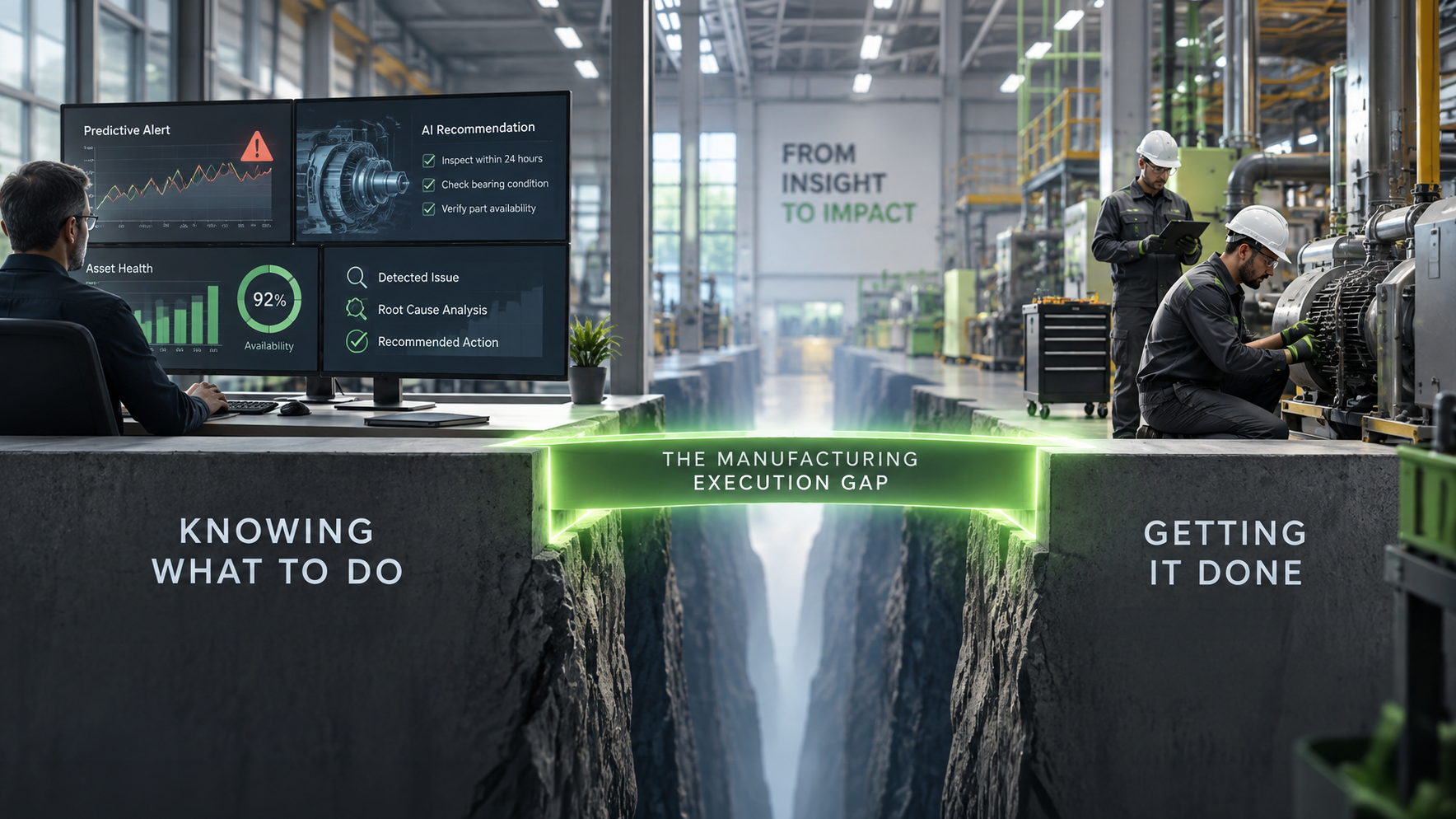
The problem is not whether manufacturers can see what is happening. The problem is what they do about it — and how fast they take the correct action. That is the Manufacturing Execution Gap.
The Gap Between Knowing and Doing
The Manufacturing Execution Gap is the distance between identifying what needs to happen and actually getting it done.
Consider a relatively simple example:
An analytics system detects abnormal vibration on a critical asset. An AI model determines that bearing degradation is the likely cause and recommends inspection within the next 24 hours.
From an intelligence perspective, the problem has been identified and a course of action recommended. Operationally, however, the work has only begun.
Who should receive the recommendation? How urgent is it? Should a work order be created? Is the required part available? Can the equipment be taken offline? What happens if nobody responds? And ultimately, was the recommended action effective?
Between "we know what should happen" and "it happened and the problem was resolved" lies an entire chain of decisions, people, workflows, systems, approvals, and handoffs.
That chain is where the Execution Gap lives.
Why the Execution Gap Exists
The gap is not the result of manufacturers lacking technology. In many cases, it exists because decades of specialized technology have optimized individual functions without coordinating execution across them.
Historians record what machines are doing. MES records what is being produced. EAM manages maintenance. Quality systems manage deviations. ERP manages business transactions. Analytics platforms identify patterns. AI increasingly generates predictions and recommendations.
Each system contributes part of the answer. But most were designed to record, manage, or analyze a particular domain and not to coordinate what should happen across the operation. As a result, execution often occurs in the spaces between systems.
A problem begins in a machine, appears on a dashboard, becomes an email, moves into a meeting, turns into a task, gets entered into another system, is discussed at shift handover, and eventually gets resolved.
The technology may be digital. The execution process often remains surprisingly manual.
AI Makes Closing the Execution Gap More Important
Artificial intelligence is rapidly expanding manufacturing's ability to understand operations. AI Agents can increasingly detect anomalies, analyze root causes, predict failures, identify quality risks, and recommend corrective actions. But this creates an important question:
What happens after AI produces an insight or recommends an action?
If an AI Agent identifies or recommends an appropriate action but execution still depends on someone reading a recommendation, deciding whom to contact, creating a task, entering information into another application, following up, escalating delays, and documenting the result, AI has accelerated intelligence without necessarily accelerating execution.
In that environment, manufacturers risk creating a new generation of sophisticated dashboards: much smarter than their predecessors, but still separated from the work required to change the outcome.
The value of AI therefore cannot be measured only by the quality of its predictions or recommendations. It must ultimately be measured by its ability to improve operational outcomes.
One multinational pharma manufacturer described the shift plainly: corrective actions now reach the line in hours, not days.
Execution Is a Closed Loop
Closing the Execution Gap requires thinking beyond individual applications and toward a continuous operational loop.
Context → Intelligence → Decision → Action → Learning → Better Context
- Data needs context so the system understands the relationship among assets, processes, production, maintenance, quality, and previous events.
- That context enables intelligence. Intelligence supports better decisions.
- Decisions must then be translated into coordinated actions across people, workflows, AI Agents, and enterprise systems.
- Actions must be followed through to resolution.
- Critically, the outcome of each action needs to be captured as learning, becoming part of what the organization knows the next time a similar situation occurs.
Without execution, intelligence produces recommendations. Without learning, execution produces activity. A truly intelligent operation needs both.
The Missing Layer in the Manufacturing Technology Stack
Manufacturing technology has historically been organized around systems of record and, more recently, systems of intelligence. What manufacturing now needs is something different: a System of Execution.
A System of Execution does not replace ERP, MES, historians, EAM, quality systems, or analytics. It connects the intelligence generated across these environments to the people, AI Agents, workflows, and systems responsible for acting on it.
Its purpose is not simply to tell the operation what is happening. It helps determine what should happen next, coordinates the response, drives action through resolution, and captures the outcome so the organization can learn from it.
When everyone has access to powerful AI, generating another insight will not necessarily be the competitive advantage. Executing better and learning faster may be.
How Decisyon Approaches the Execution Gap
This is the problem Decisyon is designed to address.
See what the gap looks like for each role, or estimate what the gap costs per quarter.
Decisyon's AI-Powered System of Execution for Manufacturing connects the operational lifecycle rather than stopping at any individual stage.
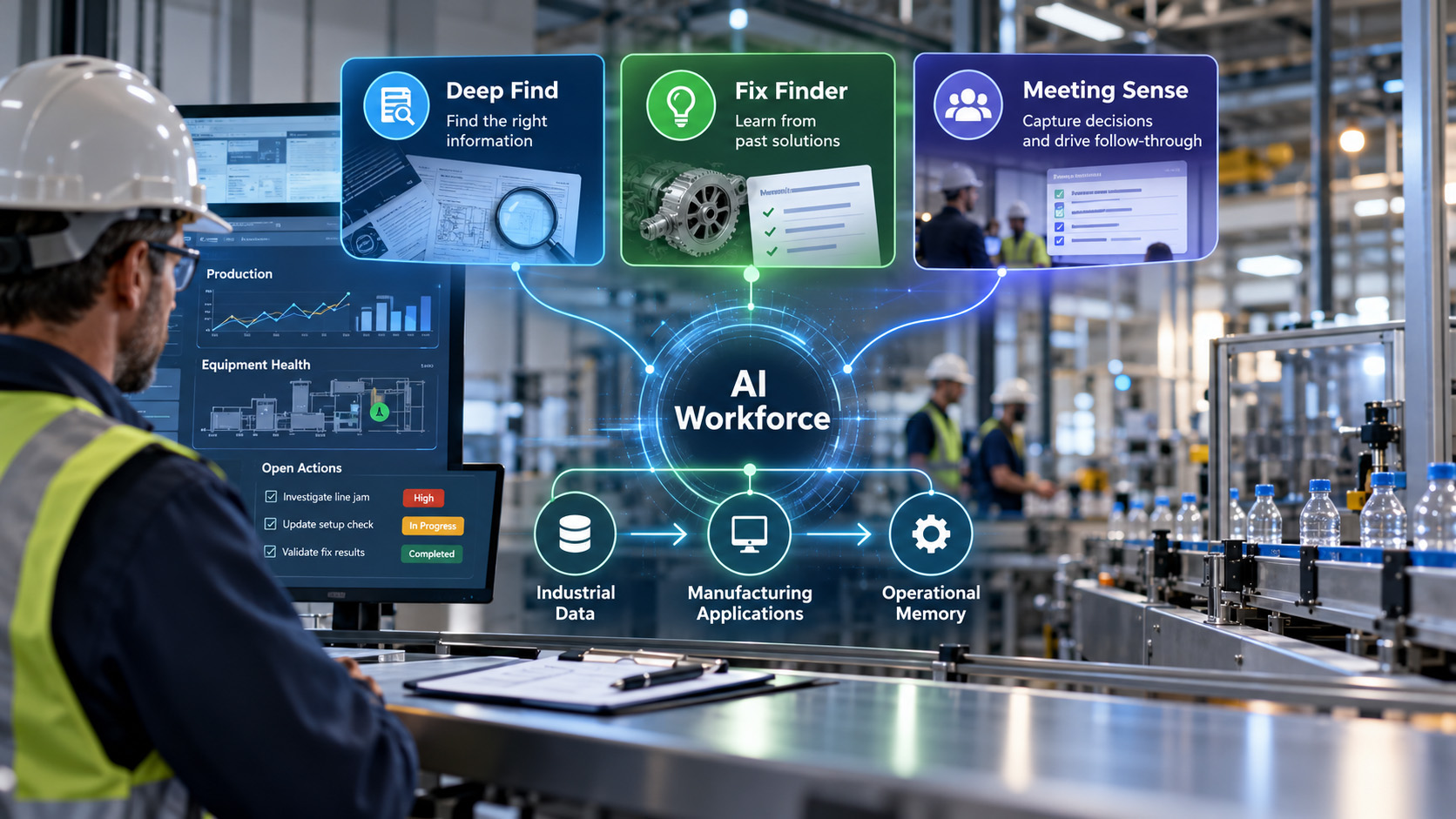
Its Agentic Data Foundation connects, contextualizes, and governs fragmented operational data so AI and people share a common understanding of the operation. Operational Intelligence and the AI Workforce use that context to detect problems, understand what is happening, and determine appropriate actions.
Decisyon then connects those decisions to Operational Execution by coordinating applications, workflows, people, AI Agents, and enterprise systems to move work through resolution.
At a global electronics and semiconductor manufacturer, Decisyon's predictive maintenance models flag failures with more than 90% accuracy, with warning windows ranging from 24 minutes to over 11 hours. The prediction is not what changed the outcome. What changed it was that the warning arrived already routed: the maintenance team could review the data, organize the recommended action, and schedule the work before the failure happened. Unplanned machine downtime at the pilot plant has been virtually eliminated.
Finally, the problem, decision, action, and outcome become part of Operational Memory, creating reusable context for future decisions. The objective is a continuously improving operational loop in which every completed action can make the next decision better informed.
The future of manufacturing AI will be determined by who can close the Manufacturing Execution Gap and turn what they know into action — and who can learn fastest from what happens next.
That is the Manufacturing Execution Gap. Closing it is the next step in turning manufacturing intelligence into operational excellence.
If you want a sense of what the gap is costing your operation, our ROI Report will give you an estimate in a few minutes.