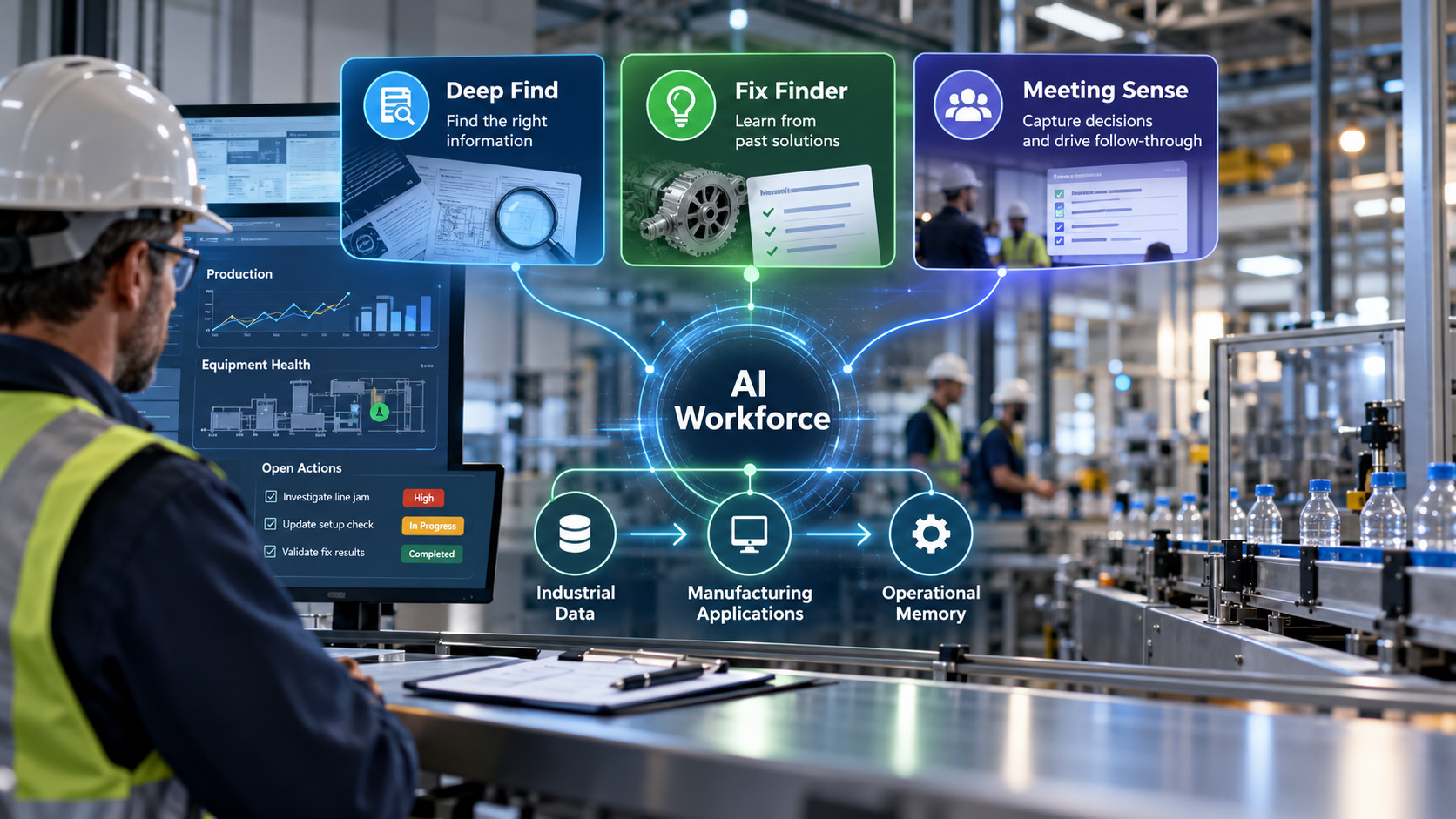
AI agents in manufacturing create value when they help people get work done and improve the business. A decision becomes an assigned action. A past fix helps resolve a recurring issue. The right procedure reaches a technician when it is needed. Working together as an AI Workforce, specialist agents help turn manufacturing intelligence into operational excellence: more efficient operations, faster time to market, lower costs and greater profit.
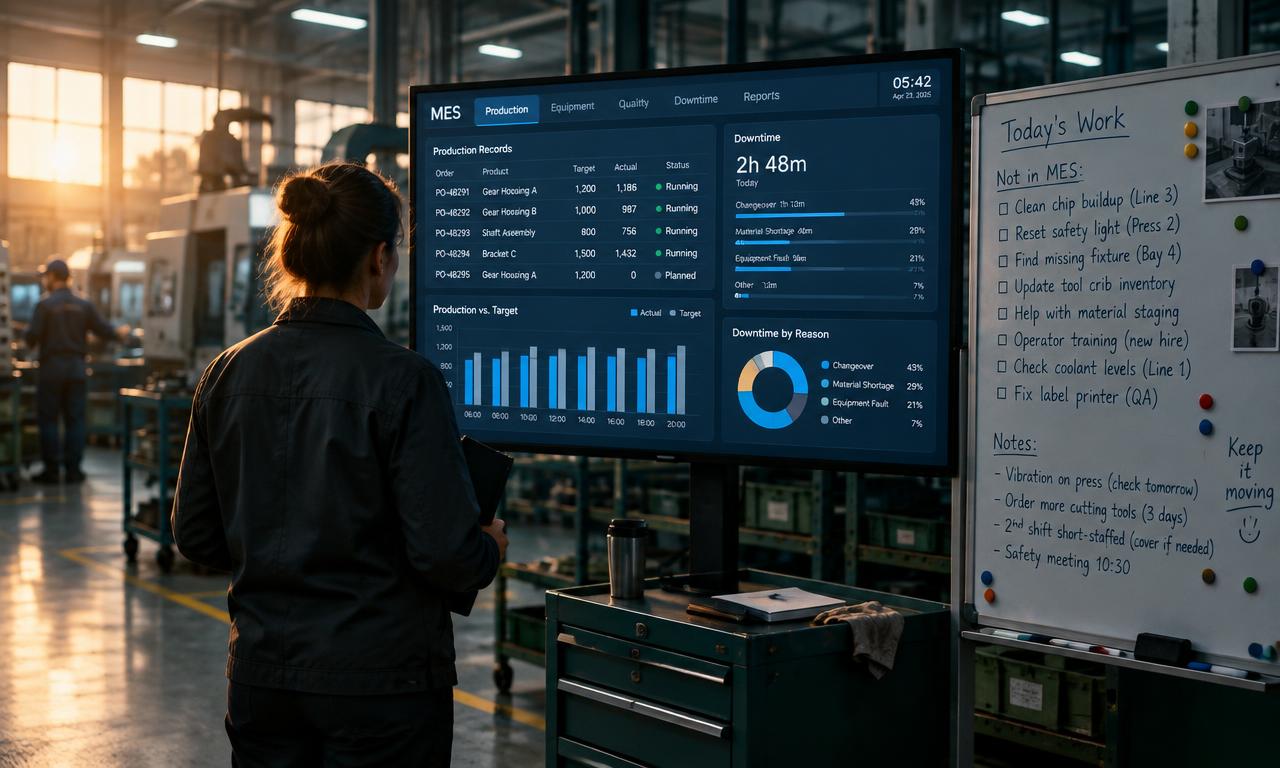
Manufacturers already invest in manufacturing execution systems (MES), enterprise resource planning (ERP), historians and analytics. Yet a problem can still be identified, discussed and left unresolved while someone searches for information or chases an owner. We call this the Manufacturing Execution Gap: the distance between knowing what needs to happen and getting it done. That gap costs production time, delays improvements and leaves value unrealized.
From individual agents to an AI Workforce
An AI agent performs a defined operational job. An AI Workforce brings those jobs together within the workflows people use to run the plant, using relevant operating information and human oversight.
Finding an answer helps one person. Connecting that answer to a decision, an owner and a checked result helps the whole operation improve. Teams spend less time on meeting administration and repeated investigations, and more time resolving problems and sustaining gains.
Decisyon brings an AI Workforce, manufacturing applications and industrial data together on one platform: the AI-Powered System of Execution for Manufacturing. Its purpose is to help turn insight into action, action into learning, and learning into better operational and business performance. Customers can start with the application that addresses their immediate challenge, such as LOOP for daily management, and expand as the business case grows.
Three operational agents that improve follow-through
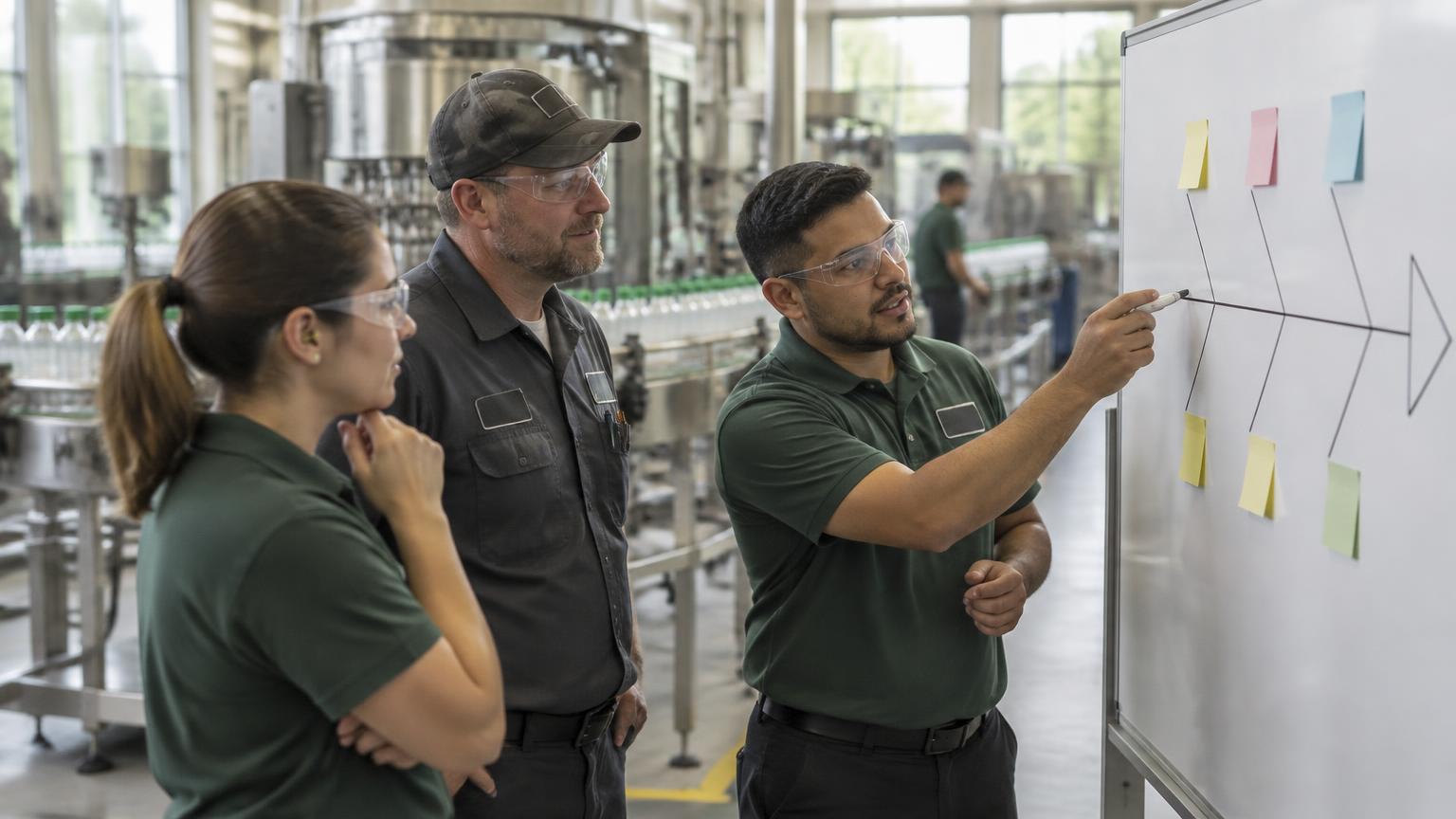
Meeting Sense captures decisions, actions, owners and deadlines from supported operational meetings. A torque check agreed at a Tier 1 huddle becomes a recorded commitment rather than a note someone must remember to transfer. Supervisors can review the record and follow up on open actions across shifts.
Fix Finder searches past incidents and corrective actions to surface relevant fixes. When a recurring fault appears on a sister line, the team can review what was tried before and whether it worked, then assess whether it fits the current conditions. This gives investigators a useful starting point while keeping responsibility for the decision with the team.
Deep Find supports natural-language search across connected SOPs, work instructions, manuals and operational records, within users' access permissions. A technician can find the procedure or engineering information needed to evaluate a repair. Teams still need to confirm the applicable revision and operating conditions before acting.
One issue from investigation to verified action
Consider a recurring packaging-line jam. Fix Finder surfaces a guide adjustment used on a similar line. Deep Find helps the technician find the adjustment specification. The technician checks the evidence, obtains any required approval and performs the work.
At the next Tier meeting, the team decides whether to update the setup check. Meeting Sense captures the decision, owner and deadline. The team checks whether the fix held and records what changed, whether the jam returned and what another line should know.
The value goes beyond completing the repair. If the fix holds, the line may lose less production time and produce more saleable output. Recording the conditions and results gives the next shift or plant evidence it can use to avoid the same loss.
Operational Memory makes learning reusable
Operational Memory is the shared record of problems, decisions, actions and checked results. It preserves why a team chose a response, the conditions in which it worked and whether the improvement lasted. It also records failed fixes, helping others avoid repeating them.
Its value grows when people can find and apply that knowledge. A new shift can pick up an open action with its history intact. Another plant can assess a previous fix before starting a fresh investigation. Teams introducing a new product can review earlier setup and quality problems, helping them prepare for a smoother production ramp-up.
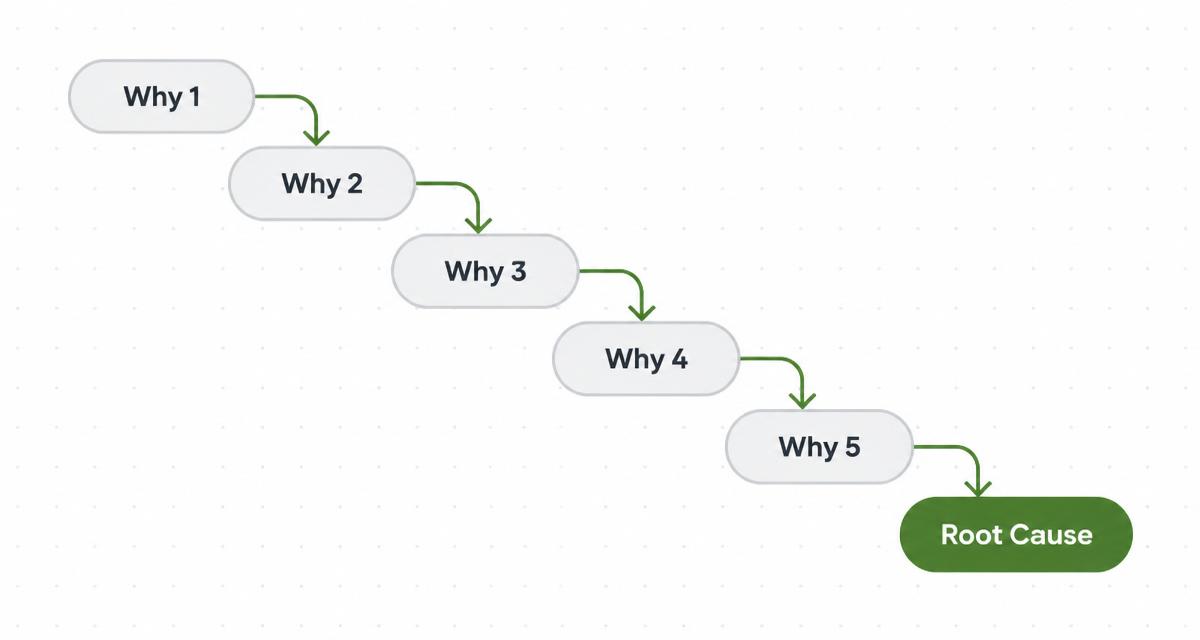
This creates an action-to-learning loop: identify the problem, review the evidence, assign and carry out the action, check the result, and save the lesson. Records need to be accurate, current and relevant. Capturing them does not automatically retrain an AI model or guarantee that a fix will work elsewhere.
People remain responsible for production decisions
Manufacturing requires more than a plausible answer. Recommendations need supporting evidence, appropriate access controls and a clear approval path. Agents assist with defined tasks, while people remain accountable for production decisions. The deployment should specify which actions require human approval and who checks the results.
The AI Workforce works with existing manufacturing and business systems, subject to the agreed integrations and application scope. It connects their information to the people doing the work and helps reduce routine searching, documentation and coordination.
Connect daily execution to business outcomes
An AI Workforce, Operational Memory and an AI-powered system of execution support the same objective: operational excellence that delivers business value. The connection becomes clear when teams link improvements in daily work to specific outcomes.
Greater operational efficiency. Less time spent finding information, preparing meetings and chasing actions gives teams more time to run and improve production. Resolving recurring problems can also help plants use equipment and labor more effectively.
Faster time to market. During product introductions and production ramp-up, teams need to resolve setup, process and quality issues quickly. Clear ownership and access to lessons from earlier launches can help shorten the path to stable production and commercial delivery.
Lower operating costs. Effective corrective actions can reduce repeat failures, scrap, rework and avoidable maintenance. Reusing knowledge can reduce the effort spent investigating problems that other teams have already addressed.
More consistent performance. Shared procedures, clear follow-through and accessible lessons help teams sustain improvements across shifts and assess where they can be applied at other plants. This supports operational excellence beyond a single successful fix.
Increased profit. Lower costs and more saleable output can improve margins. Faster launches can bring revenue forward when demand and delivery capacity are in place. These benefits must be weighed against software, integration, training and ongoing support costs.
Measure operational and business results
Start with one recurring problem and record your baseline. Measure meeting preparation and action-entry time, issue-resolution time, repeated incidents and whether completed actions actually resolved the problem. Add the production outcome that matters, such as downtime, scrap, throughput or time to reach stable production. Evaluate accuracy, adoption and integration effort alongside the gains.
Work with finance to translate checked improvements into value. Distinguish time saved from cash savings, and recovered capacity from additional output actually sold. Separate estimated benefits from realized results and avoid counting the same gain twice.
Decisyon reports that its LOOP deployment at Schneider Electric spans 218 plants, and cites the Carros plant manager's report of a 4 to 5% improvement in site performance. This is a reference for connected daily management, not proof of the contribution of any individual AI agent. Each AI use case should establish its own measurable results.
The goal is operational excellence that improves business performance. Explore Decisyon's AI Workforce and choose one workflow where better follow-through could reduce a meaningful loss or accelerate a production milestone. Define the operational measure and financial assumptions, check the results, and expand when the evidence supports it.