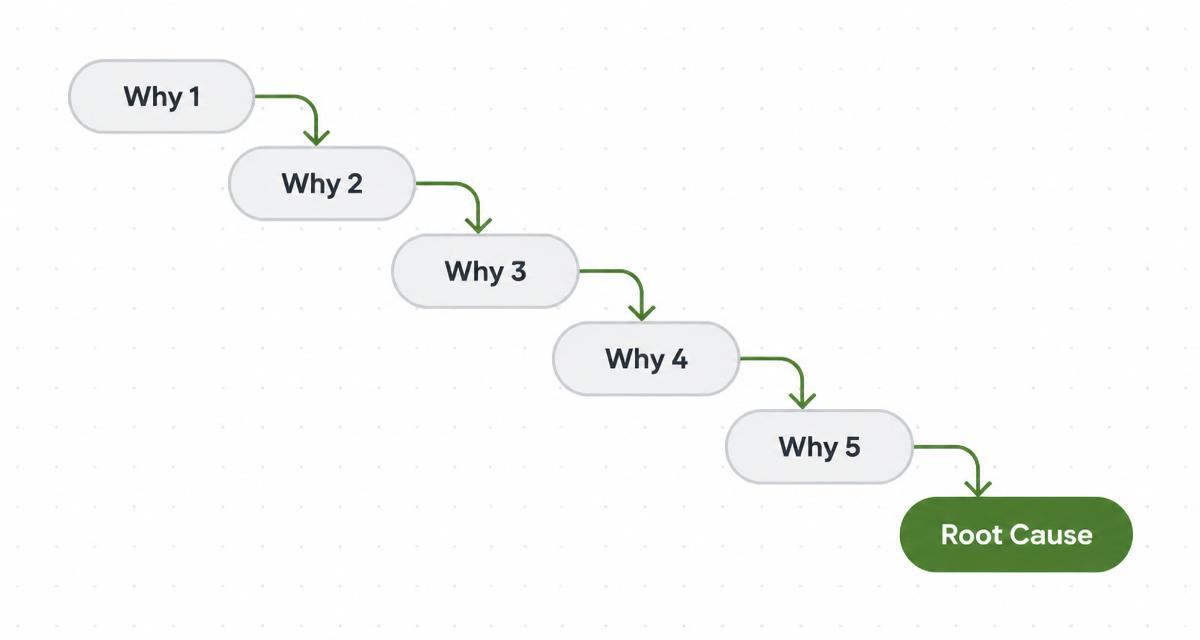

Issues get lost between shifts because the handoff is a conversation instead of a record. The outgoing supervisor explains it, the incoming one writes down half of it, and by the next day the issue has no owner, no status, and no history. The fix is not a longer overlap or a better logbook. It is a single running record where every issue carries an owner, a due date, and its full history into the next shift automatically, inside the AI-Powered System of Execution. The night shift stops rediscovering what days already knew. See what lost handoffs cost your plant in the ROI Report →
It is 6:52 a.m. at a food plant. The night supervisor is walking out with a coffee-stained notebook. A filler on Line 2 faulted twice overnight. He mentioned it to the day lead at the door, who was mid-count on a pallet and nodded. By 7:30 the filler faults again. The day shift logs it as a new issue. Maintenance asks the same diagnostic questions the night crew already answered. The repair that was ninety minutes from done is now starting over, eight hours late.
That is not a people problem. Three shifts and seven-day operations mean the person who opened the issue is almost never in the room when it closes. If the handoff lives in a conversation, a notebook, or a whiteboard photo, the issue resets every eight hours.
What a good shift handoff actually is
A handoff that works is not a meeting and not a form. It is a shared, running record with four properties:
- Every open issue has one named owner. Not "maintenance" — a person, with a due date.
- The history travels with the issue. What was tried, what the machine data showed, what was decided, and why — readable in under a minute.
- The incoming shift sees it before the tier meeting, not during it. The meeting confirms priorities instead of reconstructing the night.
- Nothing closes without evidence. The issue stays open until the line proves it is resolved.
Most plants have one of these. The plants that run all four do not have better memories — they have a system that carries the record for them.
Why issues die at shift change
Four things kill an issue at the handoff:
1. The record is a conversation
Verbal handoffs lose roughly half their content, and the half that survives is the easy half. The nuance — "we adjusted the sensor but it drifted back" — is exactly the part that gets dropped.
2. The issue lives in three places at once
The fault is in the machine historian, the work order is in the CMMS, and the context is in the supervisor's head. The incoming lead gets one of the three and rebuilds the rest from scratch.
3. Ownership resets with the crew
Night shift opens it, day shift inherits it, and neither feels responsible for the outcome. An issue with two shifts' names on it has no name on it.
4. Nobody checks what the last shift already tried
So the same diagnostic steps run again, the same dead-end fix gets reapplied, and the downtime clock keeps running on work that was already done.
What changes when the handoff is automatic
When the record carries itself, the shift change stops being a reset:
- Issues open once and stay open. One record, one owner, one timeline — visible to every shift that touches it. Meeting Sense captures the decision and the action in the tier meeting as it happens, so the context is written down before the people who made it go home.
- The history is attached, not retold. What was tried overnight is on the issue itself. The day lead reads ninety seconds of history instead of running a two-hour investigation.
- The proven fix comes forward. Fix Finder reads the corrective-action history across lines and plants and surfaces the fix that worked last time this fault appeared — so the incoming shift starts from the answer, not from zero.
- Escalation survives the shift boundary. If an issue is aging or a priority action stalls, it moves up a tier on a rule, not on whether someone remembered to mention it at the door.
This is the value chain running in the background of an ordinary Tuesday: Factory Data captured at the line becomes Manufacturing Intelligence the next shift can act on, and Manufacturing Intelligence becomes Operational Execution when the fix actually lands. Operational Excellence is what that compounds into — less repeat downtime, faster repair, fewer issues reopening under new numbers.
What it looks like on real plants
Schneider Electric runs this rhythm across 218 plants globally, with more than 100,000 registered users and 4,000+ concurrent users per shift per day. Issues are captured from the floor, escalated to plant leadership with owners and timelines, and tracked through the same daily-management routine everywhere. Philippe Sola, Plant General Manager at Carros, France: "This solution is used every day by 100% of our employees, operators or team leaders. It is at the center of our daily performance meetings and enabled us to improve our site performance by 4–5%. We have improved our reactivity, with the possibility of escalating priority actions during the course of the day." That is a handoff that survives the shift boundary, 218 plants over. Read the full breakdown.
Abafoods put 150 shop-floor users on one collaborative platform and moved corrective actions from days to hours — because the issue, the action, and the outcome stopped living in separate places and separate shifts. Internal non-conformities dropped and conformance to plan rose. Read the full breakdown.
Estimate what tighter handoffs are worth on your lines — run the ROI Report.
Notebook, shared drive, or connected system
| Capability | Notebook / verbal handoff | Spreadsheet or shared drive | AI-Powered System of Execution |
|---|---|---|---|
| Every issue has one named owner | No | Sometimes | Yes, always |
| History travels with the issue | No | Partial | Yes, automatic |
| Incoming shift sees issues before the meeting | No | If someone updates it | Yes |
| Prior fixes surface automatically | No | No | Yes |
| Stalled issues escalate on a rule | No | No | Yes |
| Issue stays open until the line proves it | No | Manual | Yes |
Most plants run the first column and pay for it in repeat diagnostics and re-opened issues. The move to the third column usually shows up first as shorter tier meetings, then as a visible drop in repeat faults.
What to ignore
Ignore any fix that starts with a longer overlap between shifts, a new handover form, or a template for better notebook entries. Those make the handoff tidier. They do not make it survive.
Three questions to ask instead:
- When an issue opens at 2 a.m., what does the day-shift lead see at 6:45 a.m. — the full history, or a line in a logbook?
- If the same fault appeared on another line or another plant last quarter, does the incoming shift get that fix, or start from zero?
- When an issue stalls for two shifts, what moves it up — a rule, or someone's memory?
If the answers are "a logbook line," "start from zero," and "someone's memory," the plant does not have a handoff problem. It has a record problem, and it is paying for it in repeat downtime every single day.
Where Decisyon fits
LOOP is Decisyon's operational excellence application — the daily-management backbone where issues are captured, owned, escalated, and verified across every shift. Inside it, Meeting Sense captures decisions and actions in the tier meeting, Fix Finder routes the proven fix to the crew that needs it, and Meeting Insight flags what is aging or recurring before the next meeting starts. One record, every shift, no reconstruction. That is the AI Workforce doing the remembering so the plant can do the fixing.
Two ways to size it for your plant:
- Run the ROI Report → — two minutes, uses your own line and plant numbers.
- Read the case studies → — Schneider Electric, Abafoods, and others running the same loop across every shift.