
Management consultant guru Peter Drucker is perhaps best known for creating one of modern management’s most famous quotes: “If you can’t measure it, you can’t improve it.” With a clearly established metric for success, you can quantify progress and adjust your processes to produce the desired outcome. Without clear objectives, you’re stuck in a constant state of guessing. In Manufacturing where profit margins are getting thinner and competition is much more global and cutthroat, two primary metrics are key to success: OLE (Overall Labor Effectiveness) and OEE (Overall Equipment Effectiveness). These two KPIs broadly measure availability/efficiency, performance and Quality of both workforce and machines.
Overall Equipment Effectiveness, or OEE, is one of the most practical ways manufacturers measure how well their equipment is actually performing in real-world conditions. Unlike isolated KPIs, OEE brings availability, performance, and quality together into a single metric that exposes hidden losses on the shop floor. See our comparison of the best operational excellence tools for manufacturing.
For manufacturers facing tighter margins, global competition, and increasing complexity, OEE benefits go beyond reporting. It helps teams pinpoint where downtime occurs, understand why output falls short of targets, and prioritize improvement actions that drive measurable results. When OEE data is visible and actionable, operations teams can move faster, reduce waste, and align production decisions with business goals. For tools that support lean manufacturing alongside OEE tracking, see our guide to the best lean operations software.
The OEE Calculation: Turning Data into Insight
To understand the benefits of OEE, one must first understand how it is derived. OEE is calculated by multiplying three key factors: Availability, Performance, and Quality.
- Availability: Accounts for unplanned and planned stops (Downtime).
- Performance: Accounts for “Slow Cycles” and “Small Stops.”
- Quality: Accounts for “Production Rejects” and “Startup Rejects.”
The resulting percentage gives you a snapshot of your production efficiency. An OEE score of 100% means you are producing only Good Parts, as fast as possible, with no Stop Time.
The following seven benefits explain why OEE has become a core metric in modern digital manufacturing environments.
- Reduced cost. OEE reduces costs by identifying and eliminating waste in the manufacturing process. This can include reducing the amount and number of materials used, the amount of time it takes to produce products, and the amount of energy consumed.
- Increased productivity. OEE increases productivity by improving the efficiency of the manufacturing processes. This can lead to more products being produced in less time, which can lead to increased profits.
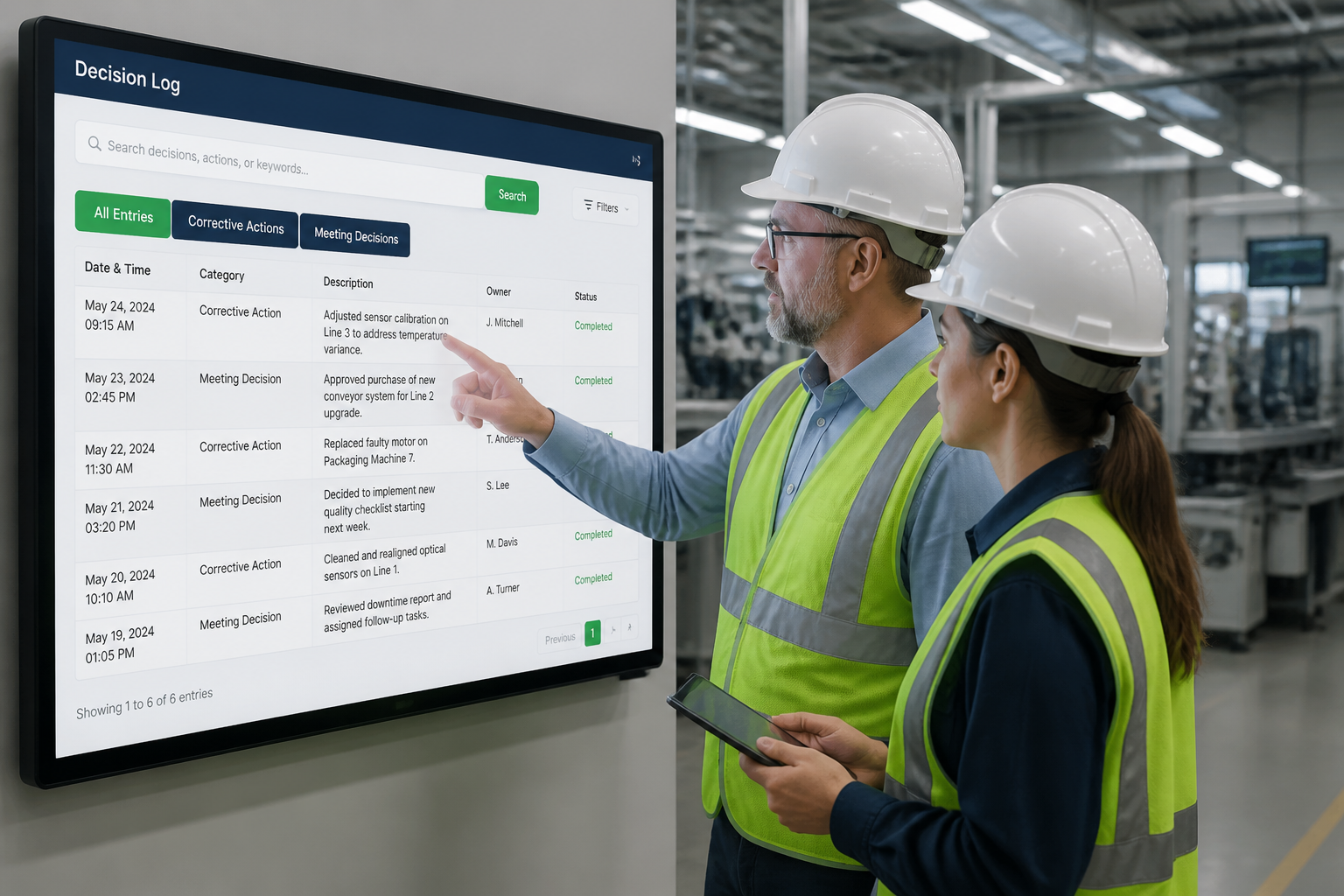
- Enhanced fact-based timely decision-making. OEE can provide valuable data that can be used to make better and smarter decisions in the manufacturing process. This will lead to improved efficiency, productivity, and profitability. By connecting OEE data with real-time operational context, manufacturers can move from reactive problem solving to proactive performance management. This is especially powerful when OEE insights are integrated into a centralized manufacturing analytics platform where teams can collaborate and track corrective actions.
- Improved customer service. OEE can help to improve customer service by reducing the time it takes to fulfill orders and by ensuring that products are delivered on time and in good condition. This can lead to increased customer satisfaction and loyalty.
- Sustainability. OEE can help to improve sustainability by reducing the number of resources used in the manufacturing process. This can help to reduce the company’s environmental impact.
- Improved collaboration between departments. OEE can help to improve the collaboration between departments involved in the process (production, maintenance, planning). This can lead to increased speed to address corrective and preventive actions. When production, maintenance, and planning teams share a common OEE view, accountability improves and corrective actions happen faster. Digital OEE solutions that support task ownership and cross-team visibility remove silos that often slow improvement initiatives.
- Path for digitalization. OEE can facilitate and even accelerate the path to digitalization. With a visual approach, users can readily access the field from an application that is intuitive and doesn’t require specialized technology knowledge. Moreover, managers will be able to rapidly access all the information they need to reduce waste and improve processes.
How Digital OEE Supports Continuous Improvement
Traditional OEE reporting often stops at dashboards. Digital OEE takes the next step by turning performance gaps into actionable improvement workflows. Teams can assign tasks, track root causes, and measure the impact of corrective actions over time. This creates a closed-loop improvement process that supports lean initiatives and long-term operational excellence.
Decisyon Digital OEE not only provides data related to the process (and indicates where to focus improvement activities), but allows stakeholders to drive actions to solve the detected issues with native collaboration and task management tools.
If you are looking for a way to improve the quality, efficiency, and profitability of your manufacturing process, then OEE is a valuable tool that can help you achieve your goals. Learn more about how Decisyon’s Digital OEE applications can benefit your manufacturing operation here.
FAQ: Common Questions About OEE and Labor Effectiveness
Q: What is a “Good” OEE score? A: While a score of 100% is the theoretical ideal, “World Class” OEE is generally considered to be 85%. However, for many manufacturers, a typical starting point is closer to 60%, with the goal of incremental improvement.
Q: How does OLE (Overall Labor Effectiveness) differ from OEE? A: While OEE focuses on machine performance, OLE measures the utilization, performance, and quality of the human workforce. Combining both metrics provides a 360-degree view of the production floor.
Q: Can OEE be used for manual assembly lines? A: Yes. While the term mentions “Equipment,” the logic of measuring availability, speed (performance), and output quality applies equally to manual processes and semi-automated cells.
Q: Why does my OEE data sometimes feel inaccurate? A: Manual data entry is the primary culprit. “Hidden losses” are often missed when operators manually log downtime. Digital OEE solutions automate data collection directly from the machines to ensure a “single source of truth.”
To understand the benefits of OEE, start with a step-by-step OEE calculation guide that shows how the metric is derived. OEE is calculated by multiplying three key factors: Availability, Performance, and Quality.