Manufacturing's Most Valuable Asset Isn't Data — It's Institutional Knowledge
Every manufacturing organization generates thousands of operational decisions every week.
A Tier meeting identifies the root cause of a recurring quality issue. A maintenance technician discovers why a critical asset keeps failing. A production supervisor adjusts a process parameter that improves yield. An engineer resolves a stubborn CIP overrun after weeks of investigation.
These decisions create value. Unfortunately, most of that value disappears almost immediately. Six months later, another shift or another plant is solving the exact same problem again. Not because the organization lacked experience — because it lacked memory.
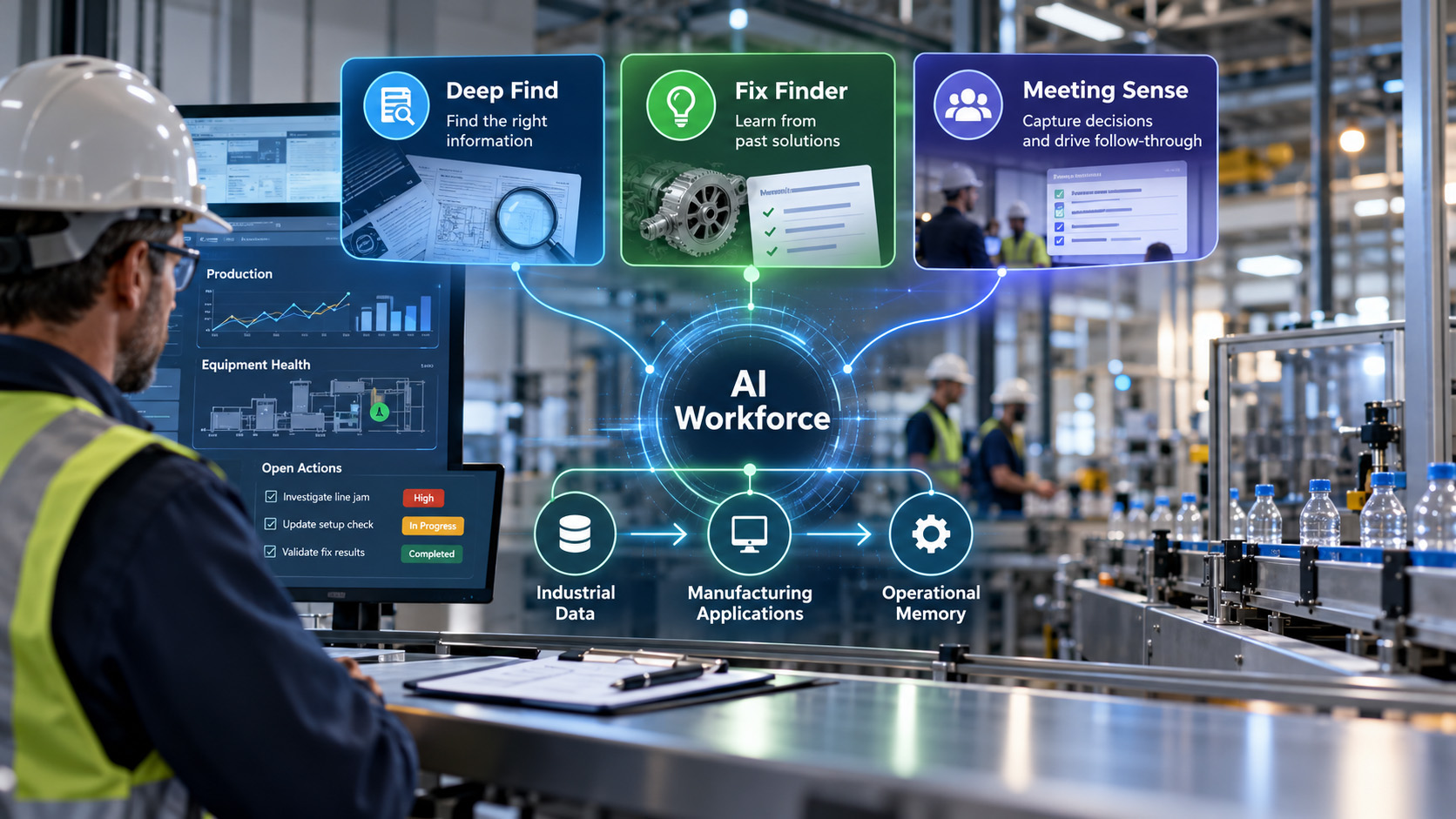
In manufacturing, competitive advantage doesn't come from collecting more factory data. It comes from turning that data into manufacturing intelligence, then into operational execution, and finally into durable operational excellence — the core loop that defines Decisyon's AI-Powered System of Execution and the AI Workforce that runs on top of it.
That's why manufacturing knowledge management is evolving from document storage into something much more powerful: an operational memory system that enables better execution. Curious how much institutional knowledge your organization may be losing? Use our ROI Advisor to estimate the impact on your operation.
Manufacturing Knowledge Management Has Changed
Traditional knowledge management focused on storing documents. Manufacturing doesn't work that way. Operational knowledge isn't created in reports — it's created in daily execution: in Tier meetings, shift handoffs, corrective actions, production reviews, and problem-solving sessions.
The challenge isn't documenting those discussions. The challenge is ensuring every future operator, supervisor, engineer, and plant manager can instantly benefit from them.
Modern manufacturing knowledge management captures operational decisions as they occur and transforms them into searchable organizational intelligence. Three sources matter most:
- Every Tier, SIM, SQDIP, and operational meeting — including decisions, owners, and outcomes.
- Every incident, deviation, CAPA, and corrective action.
- Every production context — line, product, shift, equipment, operator, and process conditions.
Individually, these are simply records. Combined, they become the operational memory of the enterprise — the layer where factory data becomes manufacturing intelligence.
Why Manufacturing Forgets So Quickly
Every manufacturing executive has experienced this frustration.
Shift turnover erases experience. Manufacturing never sleeps. Three shifts, rotating personnel, vacations, retirements, and employee turnover constantly transfer operational responsibility. Unless decisions are captured at the moment they're made, valuable experience disappears with every shift change.
Every plant solves problems in isolation. One facility solves a packaging defect. Six months later another facility repeats the exact same investigation. The organization already knew the answer. Nobody knew where to find it.
Compliance depends on remembering why. Regulated manufacturers don't simply need evidence of what happened. They need to demonstrate why operational decisions were made. Trying to reconstruct that history from PDFs, emails, spreadsheets, and personal notes creates unnecessary risk.
Most manufacturing knowledge is never documented. The most valuable operational knowledge rarely appears in formal documentation. It happens during a 15-minute Tier meeting. A hallway conversation. A shift handoff. A production review. Traditional document repositories capture reports — they don't capture operational reasoning.
From Knowledge Management to Operational Intelligence
The objective isn't simply making meetings searchable. It's enabling better decisions every day. Imagine any supervisor asking:
- "Have we seen this issue before?"
- "What corrective action worked last time?"
- "Which plant already solved this?"
- "Why did we change that process parameter?"
…and receiving an answer in seconds — complete with the meeting, owner, actions taken, and business outcome. That's the moment manufacturing intelligence turns into operational execution.
That capability fundamentally changes how manufacturing organizations operate:
- Faster onboarding. New plant managers inherit years of operational experience instead of starting from zero.
- Fewer recurring problems. The organization stops paying to solve the same issue repeatedly.
- Better operational reviews. Performance reviews become fact-based rather than memory-based. Every decision is traceable, every commitment measurable, every escalation visible.
- Stronger compliance. Every deviation connects directly to the meeting where it was discussed, the corrective action assigned, and the final outcome. Compliance becomes the by-product of disciplined execution — the definition of operational excellence.
What Modern Manufacturing Leaders Should Expect
| Capability | Traditional Document Systems | Generic Meeting Tools | AI-Powered Operational Memory |
|---|---|---|---|
| Captures operational decisions | Limited | Partial | Yes |
| Links decisions to actions and outcomes | Manual | No | Yes |
| Searches across every plant | No | No | Yes |
| Natural-language search | No | Partial | Yes |
| Supports audits and CAPA | Manual | Limited | Native |
| Available on the shop floor | Partial | Partial | Yes |
Most manufacturers still operate using the first two columns. The operational cost is hidden in every repeated issue, every delayed investigation, and every new employee learning yesterday's lessons all over again.
What This Looks Like in Practice
At Schneider Electric, LOOP supports operational performance across 218 manufacturing plants. Thousands of employees use the platform every day as the operational system supporting Tier meetings, issue management, and performance improvement. The result is a reported 4–5% improvement in plant performance, driven by better operational visibility, faster execution, and organizational learning.
At Abafoods, more than 150 shop-floor users collaborate on the same operational platform. Corrective actions that previously required days now reach production within hours because everyone shares the same operational picture. Knowledge is no longer trapped inside departments — it becomes available to the entire organization.
Where Decisyon Fits
This is exactly why Decisyon developed Meeting Sense and Meeting Insight as part of its growing AI Workforce for Manufacturing. Meeting Sense captures operational discussions as they happen. Meeting Insight transforms those discussions into enterprise-wide organizational intelligence that any employee can search in natural language.
Together, they become part of Decisyon's AI-Powered System of Execution — connecting meetings, actions, workflows, AI Agents, and operational performance inside a single platform.
The objective isn't better meeting notes. It's better execution. Because manufacturing excellence isn't determined by how much data an organization collects — it's determined by how effectively it learns from every operational decision it has ever made.
Want to see it on your data? Book a working session and we'll walk your team through Meeting Insight against a real Tier meeting.