Low-code manufacturing app development is changing how industrial teams design, build, and deploy the software they need to run smarter operations. For years, manufacturers relied on lengthy IT projects, expensive custom development, or rigid off-the-shelf systems that never quite fit the realities of the shop floor. Today, that model is being replaced by platforms that allow engineers, operations managers, and continuous improvement leaders to build exactly what they need in days, not months, without writing thousands of lines of code.
This guide covers how low-code development works in a manufacturing context, the use cases where it delivers the greatest value, and what manufacturers should look for in a platform built for the demands of industrial environments.
What Is Low-Code Manufacturing App Development?
Low-code development uses a visual, drag-and-drop interface to create applications with minimal hand-written programming. In manufacturing, this approach is extended to connect industrial data sources such as PLCs, SCADA systems, sensors, ERP platforms, and MES software, then surface that data in apps that workers can act on in real time.
Traditional enterprise software development requires specialized developers, long requirement-gathering cycles, and expensive integration work. By the time an application is live, the operational need it was built to address may have evolved. Low-code platforms short-circuit this process. Domain experts who understand production better than any software team can translate their knowledge directly into working applications: monitoring dashboards, quality escalation workflows, predictive maintenance alerts, digital work instructions, and more.
The most capable platforms go further, incorporating AI assistance that allows users to describe what they need in plain language. The platform interprets the request, scaffolds the application structure, connects the relevant data, and delivers a working prototype almost immediately. This agentic approach to development collapses timelines that once took months down to a matter of hours.
Why Traditional Approaches Fall Short in Manufacturing
Manufacturers deal with a specific set of challenges that make conventional software development particularly difficult:
- Operational complexity: Every plant has a unique combination of equipment, processes, product lines, and workflows. Generic applications rarely map cleanly onto these realities.
- Legacy infrastructure: Most factories run a mix of old and new equipment, often using different protocols, databases, and control systems that were never designed to share data.
- Speed of change: Production requirements change constantly: new products, new regulations, new quality targets, new shift structures. Software that cannot evolve at the same pace becomes a bottleneck.
- IT resource constraints: Most manufacturers do not have the internal development resources to build and maintain every application that operations needs. Backlogs grow and urgent requests go unaddressed.
Low-code addresses each of these constraints directly. Because the platform is visual and accessible to non-developers, operational teams can build and modify applications themselves. Because it is designed to integrate with industrial data sources out of the box, connecting legacy equipment and modern systems is far less painful. And because iteration cycles are short, applications can evolve as fast as operations require. This is why lean manufacturing software built on low-code principles is rapidly displacing legacy systems across the industry.
Key Use Cases for Low-Code Manufacturing Apps
The range of applications manufacturers build on low-code platforms is broad. These are the categories where organizations consistently see the most immediate value.
Production Monitoring and OEE Dashboards
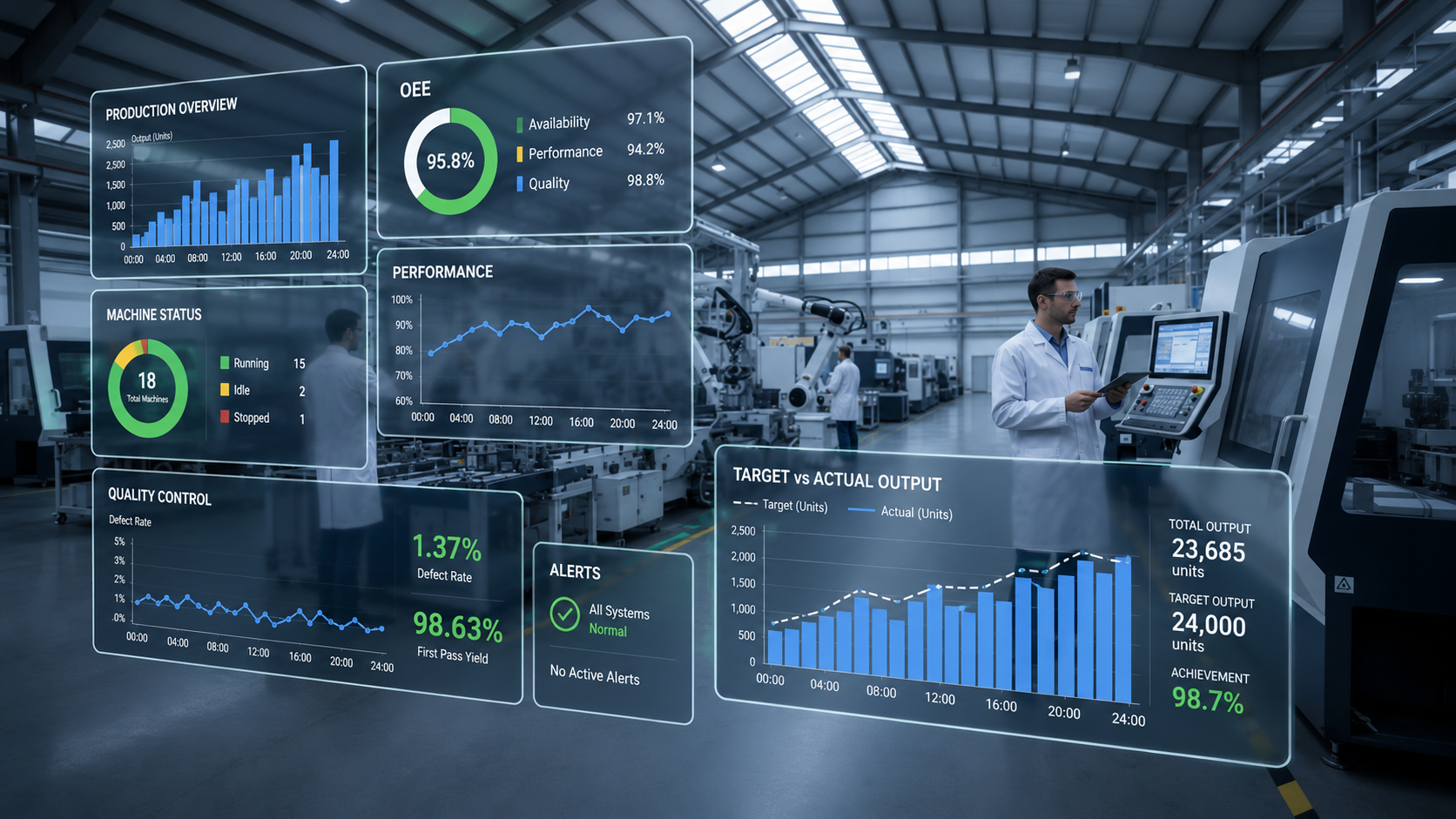
Visibility into equipment and line performance is foundational to any improvement program. Low-code platforms allow manufacturers to pull together data from multiple machines, lines, and systems into a unified view, showing availability, performance, and quality metrics in real time. Teams can build dashboards tailored to a specific role, whether that is a shift supervisor watching live throughput or a plant manager comparing performance across production lines.
Rather than waiting for a centralized IT team to create a report, the people who actually use the data can build what they need and adjust it as requirements change. Dedicated OEE software for manufacturing teams built on low-code platforms is now one of the fastest-growing categories in industrial operations.
Downtime Triage and Root Cause Analysis
Unplanned downtime is one of the highest-cost problems in manufacturing. When a line stops, operators need to record the event, identify the cause, escalate to maintenance, and document the resolution, often across multiple disconnected systems. Low-code apps can bring this entire workflow into a single interface, routing alerts to the right people, capturing cause codes, tracking mean time to repair, and feeding data back into a system that improves future predictions.
AI agents embedded in more advanced platforms go further by cross-referencing downtime events against historical patterns, sensor data, and maintenance records to suggest probable causes before a technician has even reached the machine.
Quality Management and Escalation Workflows
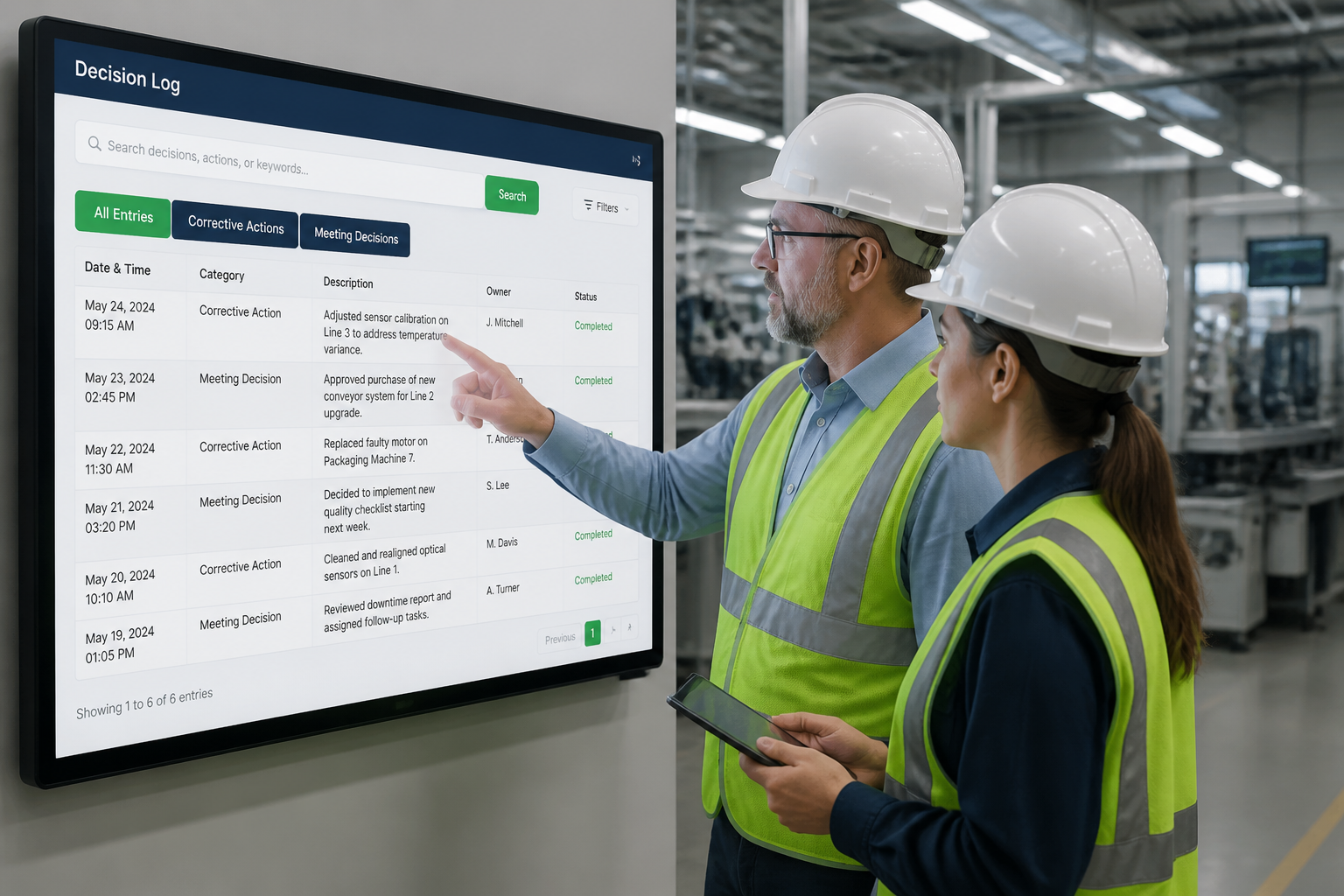
Managing quality in a regulated manufacturing environment means capturing deviations, triggering corrective actions, maintaining audit trails, and ensuring nothing falls through the cracks. Low-code platforms allow quality teams to build apps that automate these workflows, routing quality events to the right reviewers, enforcing checkpoints, capturing electronic signatures, and generating the documentation that auditors require.
Because the platform is flexible, the workflow can match the actual quality process in use at each plant rather than forcing the plant to adapt to a rigid system.
Digital Work Instructions
Standardizing how work gets done is a persistent challenge, particularly in multi-site organizations with high operator turnover. Low-code platforms make it practical to build digital work instructions that are tied to specific production orders, updated in real time when procedures change, and accessible on tablets or screens at the point of use. Operators see the right instruction at the right moment, and supervisors can verify that steps are followed and documented.
Predictive Maintenance and Asset Performance
Predictive maintenance applications require integrating sensor data from equipment, applying analytics or machine learning models to detect early warning signs, and routing alerts to maintenance teams before failures occur. Low-code platforms with built-in IoT connectivity and analytics capabilities allow maintenance teams to build these applications without writing custom data pipelines or building models from scratch. Pre-built components and templates accelerate the initial build, while the platform handles the ongoing data ingestion and model refresh automatically.
For a deeper look at how these capabilities work in practice, see how Decisyon approaches predictive maintenance with integrated AI and low-code tooling.
Supply Chain and Inventory Visibility
Manufacturers increasingly need real-time visibility into material availability, supplier status, and inventory levels, especially in environments where Just-in-Time production leaves little margin for error. Low-code apps can surface this data across systems, trigger alerts when stock falls below thresholds, and connect supply-side data to production scheduling in ways that help operations respond faster to disruptions.
What to Look for in a Low-Code Platform for Manufacturing
Not every low-code platform is designed for industrial use. Consumer-oriented or general-purpose tools often lack the connectivity, security, and scalability that manufacturing environments require. When evaluating platforms, these are the capabilities that matter most.
Native Industrial Connectivity
A manufacturing-grade low-code platform must connect to the systems and protocols that factories actually run. This includes OPC UA, MQTT, Modbus, REST APIs, and integration with ERP systems like SAP and Oracle, as well as MES, CMMS, and quality platforms. Without this connectivity built in, every application starts with a complex custom integration project.
AI-Powered Development
The most advanced platforms are moving beyond drag-and-drop to natural language development. Users describe what they want: “I need an app that shows downtime events by machine and routes alerts to the on-call maintenance tech,” and the platform builds the scaffolding instantly. This capability dramatically lowers the barrier to application creation and allows experienced operators and engineers to become effective app builders without deep technical training.
Decisyon App Composer takes this approach, using agentic AI to interpret natural language requirements and generate application structures that users can then refine and extend. Teams that previously waited months for IT to build an application can now move from idea to working prototype in hours.
Scalability Across Sites
A pilot project at one plant is one thing. Deploying to 50 or 200 plants is another. The right platform supports federated deployment, where each plant can build and modify its own applications while staying within enterprise governance standards. Central IT teams can define data models, security policies, and component libraries that local teams use as building blocks, ensuring consistency without sacrificing flexibility.
Decisyon’s platform has demonstrated this at scale, supporting deployments across hundreds of plants and tens of thousands of users from a single architecture. This capability is central to what makes it a true lean MES solution for enterprise manufacturing organizations.
Agentic AI for Continuous Intelligence
Beyond the development experience, the most capable platforms embed AI agents inside the applications themselves. These agents continuously monitor operational data, surface insights, recommend actions, and in some cases execute corrective workflows automatically. This moves the platform from a passive reporting tool to an active participant in operations, one that helps teams get ahead of problems rather than simply recording them after the fact. For a look at how this is playing out across the industry, see how AI agents are transforming factory operations.
Enterprise Security and Compliance
Manufacturing applications often handle sensitive production data, proprietary process parameters, and regulated quality records. The platform must support role-based access control, audit logging, data encryption, and compliance with industrial standards. Deployment flexibility, meaning on-premise, edge, cloud, or hybrid options, is also essential for organizations with strict data sovereignty requirements or operational technology environments that cannot connect to public cloud infrastructure.
How Low-Code Development Changes the Build Process
Traditional software projects follow a linear path: gather requirements, design, develop, test, deploy, and then wait months to incorporate feedback. Low-code manufacturing development is fundamentally different.
With a mature low-code platform, the development cycle looks more like this:
- Describe the problem: An operations leader or engineer articulates what they need, often in plain language or a simple brief. AI assistance scaffolds an initial application structure in minutes.
- Connect the data: The platform connects to the relevant data sources using pre-built connectors. This might take hours instead of weeks.
- Build and iterate in the field: The team refines the application on real data, adjusting layouts, workflows, and alerting logic based on immediate feedback from the people who will use it.
- Deploy and scale: Once validated at one site, the application can be rolled out to additional plants with governance controls ensuring consistency.
- Evolve continuously: As operational needs change, the application evolves with them, without a software project request and a six-month queue.
This is why leading manufacturers are reporting 10x faster development cycles compared to traditional approaches, along with significant reductions in the IT resources required to maintain and expand their application portfolios. Manufacturers pursuing smart factory implementation are increasingly starting with low-code as the enabling layer for rapid capability deployment.
The ROI Case for Low-Code Manufacturing Apps
The business case for low-code manufacturing app development is compelling across several dimensions.
Faster time to value: Applications that would previously take six to twelve months to build and deploy can be live in weeks. This alone changes the economics of digital transformation, allowing manufacturers to pursue a larger number of high-value initiatives simultaneously rather than rationing IT resources.
Lower development cost: By enabling domain experts to build applications without full-time developer involvement, organizations reduce the per-application cost significantly. Total cost of ownership drops further because the platform handles upgrades, integrations, and infrastructure management centrally.
Operational improvement: The applications themselves generate measurable returns. OEE improvements of 3 to 5 percent, achieved within weeks of deployment, translate directly to throughput gains and cost reduction. Predictive maintenance applications that prevent one or two major failures per year can pay back the entire platform investment.
Scalability: Once an application is validated at one site, it can be replicated across dozens or hundreds of plants. The investment in building a quality escalation workflow or a predictive maintenance app at one plant becomes a global asset rather than a local solution.
Decisyon customers running multi-site programs have reported average ROI of 250%, a figure that reflects the compounding effect of operational improvements across large manufacturing footprints.
Getting Started with Low-Code Manufacturing App Development
For organizations evaluating this approach, a few starting principles help ensure success.
Start with a high-value, well-defined problem. The best first projects are those where the operational need is clear, the data is accessible, and the business impact is measurable. Downtime tracking, OEE visibility, and digital work instructions are common starting points that deliver results quickly and build internal confidence in the platform.
Involve operations from day one. The biggest advantage of low-code development is that the people who understand the problem can build the solution. Engaging shift supervisors, quality managers, and maintenance leads early, as co-builders rather than just reviewers, produces better applications and drives adoption.
Choose a platform built for manufacturing, not adapted for it. General-purpose low-code tools can handle simple forms and workflows, but they fall short when data volumes increase, industrial protocols need to be supported, or applications need to run reliably on the shop floor. The investment in a manufacturing-native platform pays off in the long run.
Plan for scale from the start. Architecture decisions made at the pilot stage, including data models, governance structures, and component libraries, affect how easily the solution scales to additional plants. Platforms that support federated deployment with centralized governance make this transition much smoother.
To understand how low-code digital factory solutions can accelerate your specific use cases, explore how Decisyon’s platform enables rapid application development across industrial environments, from single-plant pilots to enterprise-wide deployments across hundreds of sites.
Frequently Asked Questions
What is low-code manufacturing app development?
Low-code manufacturing app development is the process of building industrial software applications using visual, drag-and-drop tools and AI assistance rather than traditional hand-written code. It allows engineers, operations managers, and domain experts to create custom manufacturing apps: dashboards, workflow tools, monitoring systems, without deep programming expertise.
How long does it take to build a manufacturing app with a low-code platform?
With a mature low-code platform designed for manufacturing, simple applications can be built and deployed in hours to days. More complex applications with multiple data sources, AI-driven analytics, and cross-site deployment typically take one to four weeks, compared to months or years with traditional software development approaches.
Can low-code platforms connect to legacy manufacturing equipment?
Yes, manufacturing-grade low-code platforms support industrial communication protocols including OPC UA, MQTT, Modbus, and REST APIs, enabling connectivity to PLCs, SCADA systems, sensors, and older equipment that predates modern data standards. The key is selecting a platform with industrial connectivity built in rather than adapted from a general-purpose tool.
What is the difference between low-code and no-code for manufacturing?
Low-code platforms allow users to build applications with minimal programming, using visual tools for most of the work while allowing code insertion for edge cases. No-code platforms require no programming at all. For manufacturing applications that need to handle complex data models, industrial protocols, and AI-driven logic, low-code platforms typically offer greater flexibility and power while still remaining accessible to non-developers.
How does AI improve low-code manufacturing app development?
AI enhances low-code development in two ways. First, it accelerates the build process by interpreting natural language descriptions and automatically generating application structures, data connections, and workflow logic. Second, it adds intelligence to the applications themselves, through embedded agents that monitor operations, surface insights, recommend actions, and in some cases execute corrective workflows autonomously.