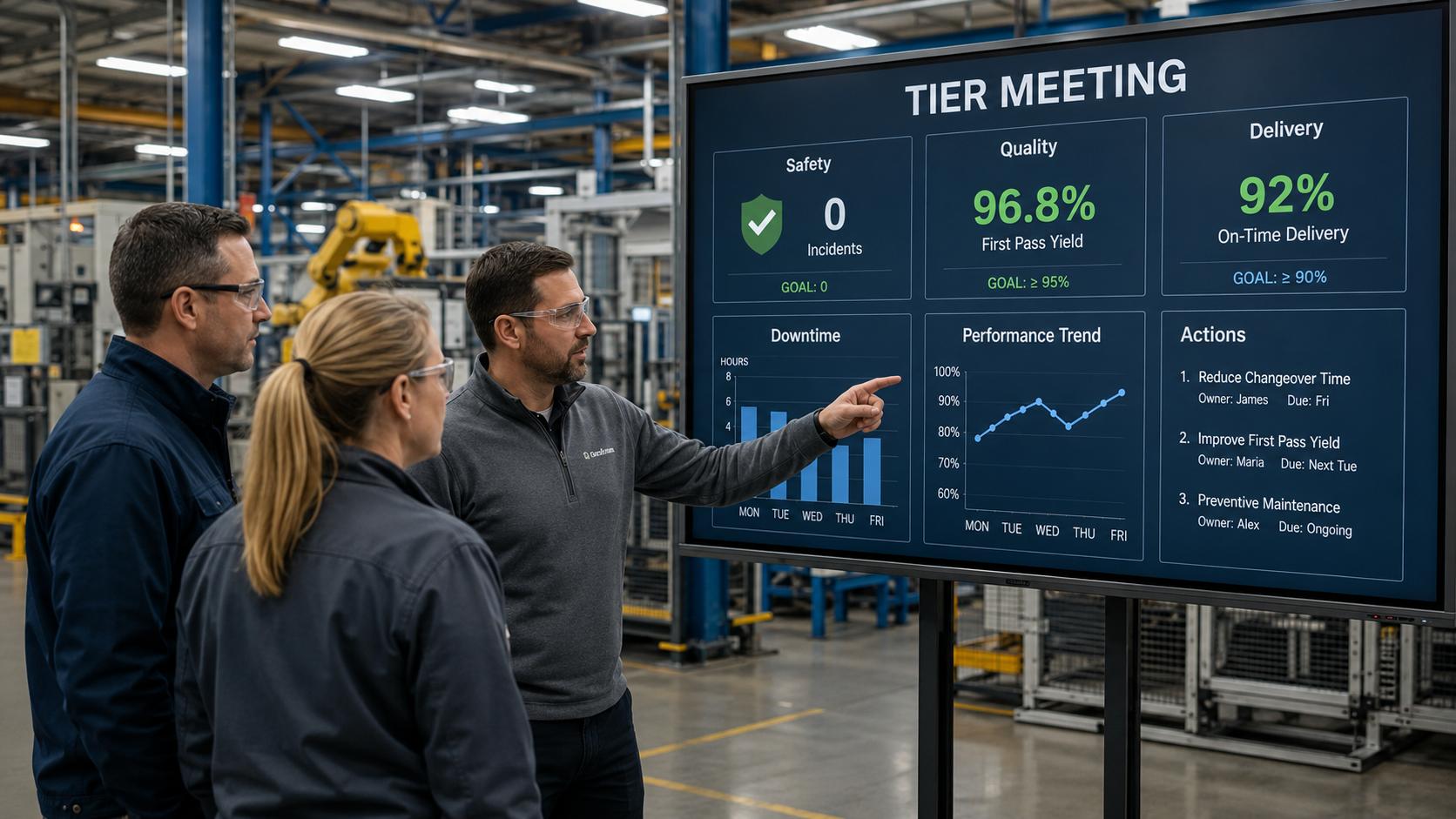
A tier meeting that ends in decisions nobody owns is a status report with a whiteboard in front of it. The plants that get real value from daily management are not the ones with better agendas. They are the ones where an action leaves the room with one name on it, escalates by itself when it stalls, and is still findable eighteen months later by a supervisor at a different site. Score yourself on the ten questions below. Then see what the gap is costing you. It is 7:15 on a Tuesday. Eleven minutes at the SQDIP board, and the shift leader is running it well. The numbers are up, the board is current, the right people are standing there. Line 3 came down again on the same fault it came down on in March, and in November before that. Nobody in the room is doing anything wrong. The meeting is fine. What fails is the twelve hours after it, when the decision made at 7:26 has to survive a shift change, a supervisor's day off, and a maintenance queue that was set before anyone in this room spoke. That is not a data problem. Every plant in this situation already has the data. It is what happens to a spoken commitment once the people who made it walk away.
Why the losses are hard to see
An execution gap does not arrive as one number. It arrives as four small ones that never get added together. A changeover that takes eleven minutes longer than the standard because the fix from last quarter never made it into the work instruction. A corrective action marked complete that was never verified against the line. A supervisor spending forty minutes assembling a morning summary that the last shift already knew. And a fault that another plant in the network solved eight months ago, being diagnosed again from scratch by someone who has no way of knowing that. None of those show up as a line item. All of them bill you every week.
The audit
Ten questions. Answer each one yes or no, honestly, about the meeting you actually run rather than the one on the standard work document. If you have to check with someone before you can answer, that is a no.
Ownership: does the meeting produce anything?
- Every action leaving today's meeting has one person's name attached, not a department or a shift.
- Every action has a due date that somebody set out loud, not a default.
- You can see last week's actions right now, without asking anyone to pull them together.
Follow-through: does anything close?
- Someone checks whether the fix held, not just whether the task got marked done.
- An action that stalls escalates on its own, without depending on a person noticing that it stalled.
- You know what percentage of last month's actions actually closed. If you would have to estimate, that is a no.
- When the same issue comes back, the meeting knows it is a repeat before someone in the room says so.
Memory: does the knowledge survive?
- The next shift knows what this shift decided without a phone call or a hallway conversation.
- When a problem recurs, anyone on the floor can find what was done about it last time in under a minute.
- A fix that worked at one plant is findable by the other plants without someone remembering to send an email.
What your score means
8 to 10. Your daily management is doing real work. The execution gap is probably not your constraint, and your next gain is more likely to come from asset health or line-level visibility than from the meeting. 5 to 7. The most common result, and the most expensive one. The meeting works. The twelve hours after it do not. Actions get created and then depend on individual memory to survive, which means your follow-through quality tracks the attentiveness of whoever happens to be on shift. 0 to 4. The meeting is a status report. It informs people, and it does not change what happens on the line. This is not a discipline problem and it will not be fixed by a stricter agenda. There is nothing carrying the decision out of the room. Most plants score high on ownership and low on memory. That is worth sitting with, because ownership is the part everyone works on and memory is the part that determines whether the same problem comes back.
What the tiers look like side by side
| Capability | Whiteboard | Shared doc or spreadsheet | Connected daily management |
|---|---|---|---|
| Action captured with an owner | Sometimes | Yes | Yes |
| Visible to the next shift without asking | No | If they open it | Yes |
| Stalled action escalates on its own | No | No | Yes |
| Fix verified against the line | No | No | Yes |
| Closure rate you can actually report | No | Manual count | Yes |
| Repeat issue flagged as a repeat | No | No | Yes |
| Fixes findable across plants | No | No | Yes |
| Most plants sit in the middle column and assume they are close to the right one. The distance between them is not features. It is whether anything happens when nobody is watching. |
What it looks like when it holds
Schneider Electric runs connected daily management across 218 plants with over 110,000 registered users, and configures a new plant in about four hours. The reported gain is a 4 to 5% improvement in plant performance, and it comes from follow-through rather than from better reporting. Read the full breakdown. A multinational pharmaceutical manufacturer replaced email and meeting chains with real-time collaboration across departments, and cut the time it took for a corrective action to reach the line. Read the full breakdown. Neither plant fixed its meeting. Both stopped depending on the meeting to be the thing that carried the work.
Four questions to ask any vendor in this category
Skip the demo of the board layout. Everyone's board looks good.
- When an action stalls past its date at 2 a.m., what happens without anyone doing anything?
- How does the next shift see what this shift decided, and does anyone have to remember to tell them?
- Show me how someone on the floor finds the corrective action from the last time this fault happened.
- If a different plant already solved this, how does the operator standing at the line tonight find out? If the answers are nothing, a handover call, a search through someone's notes, and they would have to ask around, you are buying a board.
Where Decisyon fits
LOOP is the layer that carries a decision out of the meeting. An issue raised at the board becomes an owned action with a date, escalates on its own when it stalls, gets checked against the line rather than against a checkbox, and stays findable afterwards. Meeting Sense, one of the agents in the Decisyon AI Workforce, captures the decisions, owners and deadlines from tier, SIM and SQDIP meetings as they are made, so the follow-up does not depend on notes or on the person who took them. Open actions carry forward into the next shift already owned. What changes is not the eleven minutes at the board. It is the twelve hours after it, and whether the same fault is standing in front of you again next quarter. See what that is worth on your lines → · Read the customer results →