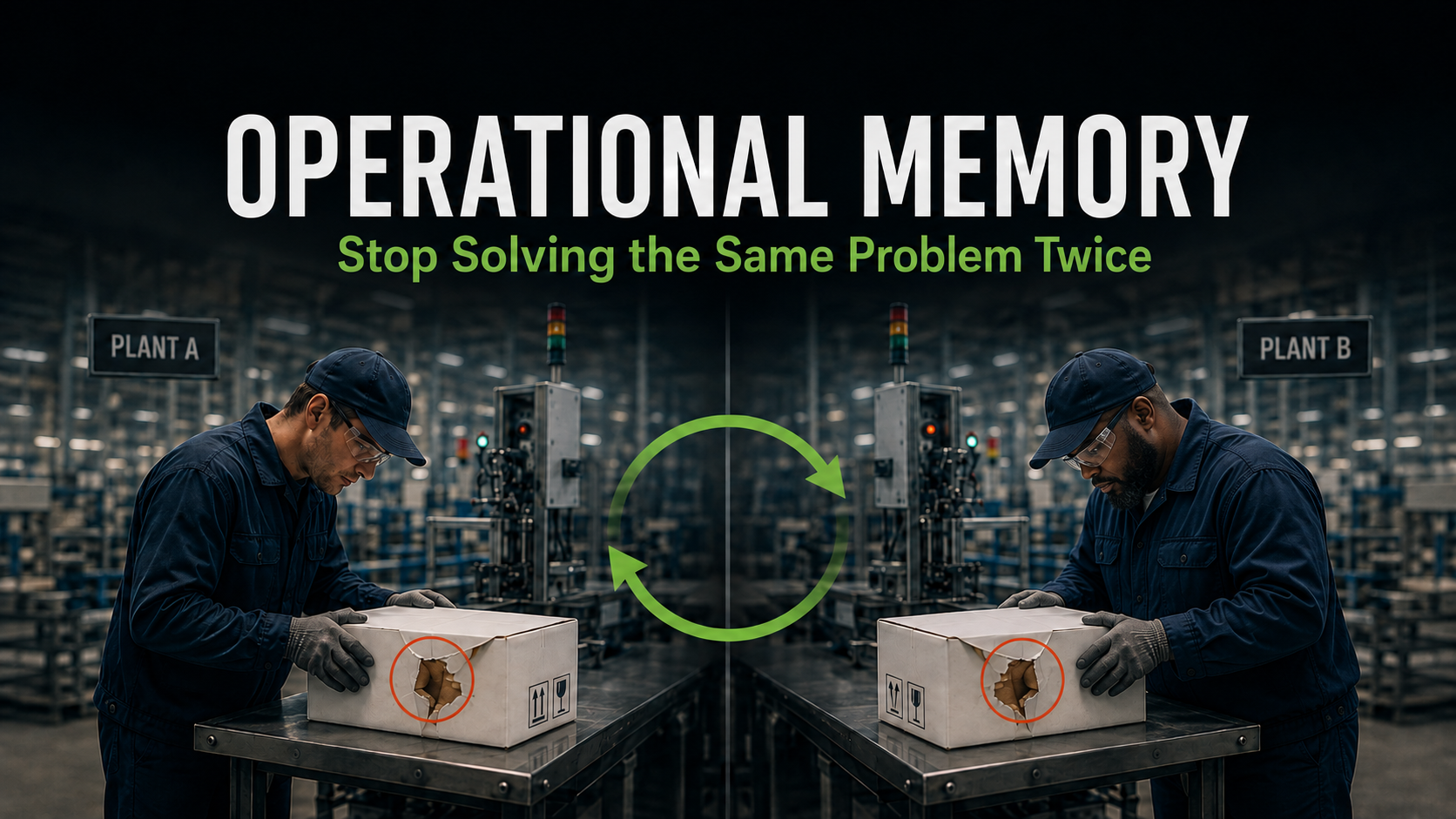
A plant solves a packaging defect in March. Six months later, a sister plant runs the same investigation from the beginning. Same defect, same root cause, same weeks of engineering time spent arriving at an answer the company already owned. See what the forgetting is costing you in the ROI Report.
I have seen this pattern inside manufacturers that have every system they are supposed to have. ERP. MES. Historians. Dashboards. Analytics. Now generative AI layered on top of all of it. The data is there. The intelligence is there. What is missing is memory.
We call this Operational Memory: the accumulated record of what happened, what was decided, what action was taken, why it was taken, and what ultimately worked.
Every manufacturing organization makes thousands of operational decisions a week. A Tier meeting isolates the root cause of a recurring quality issue. A technician works out why a critical asset keeps failing. A supervisor adjusts a process parameter and yield improves. An engineer finally resolves a CIP overrun after weeks of investigation.
Each of those decisions creates value once. Then most of that value evaporates, because the reasoning behind it never leaves the room where it happened.
What forgetting actually costs
Shift turnover erases experience. Manufacturing never stops. Three shifts, rotating crews, vacation coverage, retirements, and ordinary turnover move operational responsibility constantly. If a decision is not captured at the moment it is made, it leaves with the person who made it.
Plants solve the same problems in isolation. One facility gets to the answer. Another repeats the work from scratch. The company already knew. Nobody knew where to look.
Compliance depends on remembering why. Regulated manufacturers need more than evidence of what happened. They need to show why a decision was made. Reconstructing that from PDFs, email threads, spreadsheets, and personal notebooks is slow, and it is risky.
The most valuable knowledge is never written down. It surfaces in a fifteen-minute Tier meeting, a shift handoff, a hallway conversation, a production review. Document repositories capture reports. They do not capture reasoning.
What it looks like when the memory is there
At Schneider Electric, Decisyon's LOOP (Lean Operations Optimizer) application supports operational performance across 218 Schneider plants. Thousands of employees use it every day to run Tier meetings, manage issues, and drive performance improvement. Across the deployment, Schneider has reported a 3–5% improvement in plant performance.
Just as importantly, the operational decisions, issues and actions generated through daily management no longer have to disappear when the meeting ends.
At Abafoods, more than 150 shop-floor users work from the same operational picture. Corrective actions that used to take days now reach production in hours.
Neither result came from collecting more data. Both came from making decisions that were already being made retrievable by everyone else.
Why generic AI does not close this gap
Most AI conversations in our industry are about model selection and copilot deployment. Those matter. They are not sufficient.
A general-purpose model understands language. It does not understand your operation. It does not know why a line was slowed in March, why a maintenance strategy changed, why a deviation was classified the way it was, or why a Tier meeting chose one corrective action over another.
That context is not in the model. It lives in your operational history, and for most manufacturers that history is scattered across meeting notes, inboxes, and the memories of people who may not be here next year.
Give AI Agents access to that operational history and context, however, and their value changes dramatically. Instead of responding only from general knowledge, they can surface relevant precedent: what happened before, what was tried, what worked, and what the organization learned.
Four questions a supervisor should be able to answer in seconds
- Have we seen this issue before?
- What corrective action worked last time?
- Which plant already solved this?
- Why did we change that process parameter?
Finding the answer is only the beginning. Operational Memory becomes truly valuable when it influences the next decision and the next action.
If an AI Agent recognizes that another plant has already encountered the same failure, it should not simply retrieve the old meeting notes. It should surface the previous root cause, corrective action and outcome; help determine whether the same response applies now; and, where appropriate, initiate and coordinate the work required to resolve it.
That is where Operational Memory becomes part of a System of Execution.
Today, answering any one of these questions means finding the right person and hoping they remember. It should mean asking the question and getting the meeting, the owner, the action taken, and the outcome.
When that becomes routine, four things follow. New plant managers inherit years of operational experience instead of starting at zero. The company stops paying repeatedly to solve the same issue. Operational reviews become fact-based rather than memory-based, with every decision traceable and every commitment measurable. And compliance becomes a by-product of disciplined execution, because every deviation already connects to the meeting where it was discussed and the action that closed it.
Where we come in
Decisyon's AI Workforce helps turn everyday manufacturing activity into reusable Operational Memory.
The Meeting Sense agent captures operational discussions, decisions, actions and commitments as they happen. The Meeting Insight agent turns those conversations into structured, searchable intelligence. Deep Find and Fix Finder help teams retrieve relevant precedent and proven resolutions when similar problems emerge.
But remembering is only part of the job. Across Decisyon's AI-Powered System of Execution, specialized AI Agents can monitor operations, identify issues, surface relevant experience, recommend actions, coordinate follow-through and capture the outcome.
The result is a continuous loop: the organization remembers what it learned, applies that knowledge to the next decision, executes the action, and learns again.
The goal isn't to replace the people who hold operational knowledge. It is to make their experience available to the organization long after the meeting, shift, or even their tenure with the company has ended.
The advantage is not more data
The manufacturers who pull ahead over the next five years will not be the ones with the most data. Everyone has the data. They will be the ones whose organizations stop forgetting.
Because the real advantage of AI in manufacturing will not come simply from knowing more. It will come from remembering what the organization has learned and using that memory to make the next decision and execute the next action better.
If you want a sense of what the forgetting is costing you, our ROI Report will give you an estimate in a few minutes.