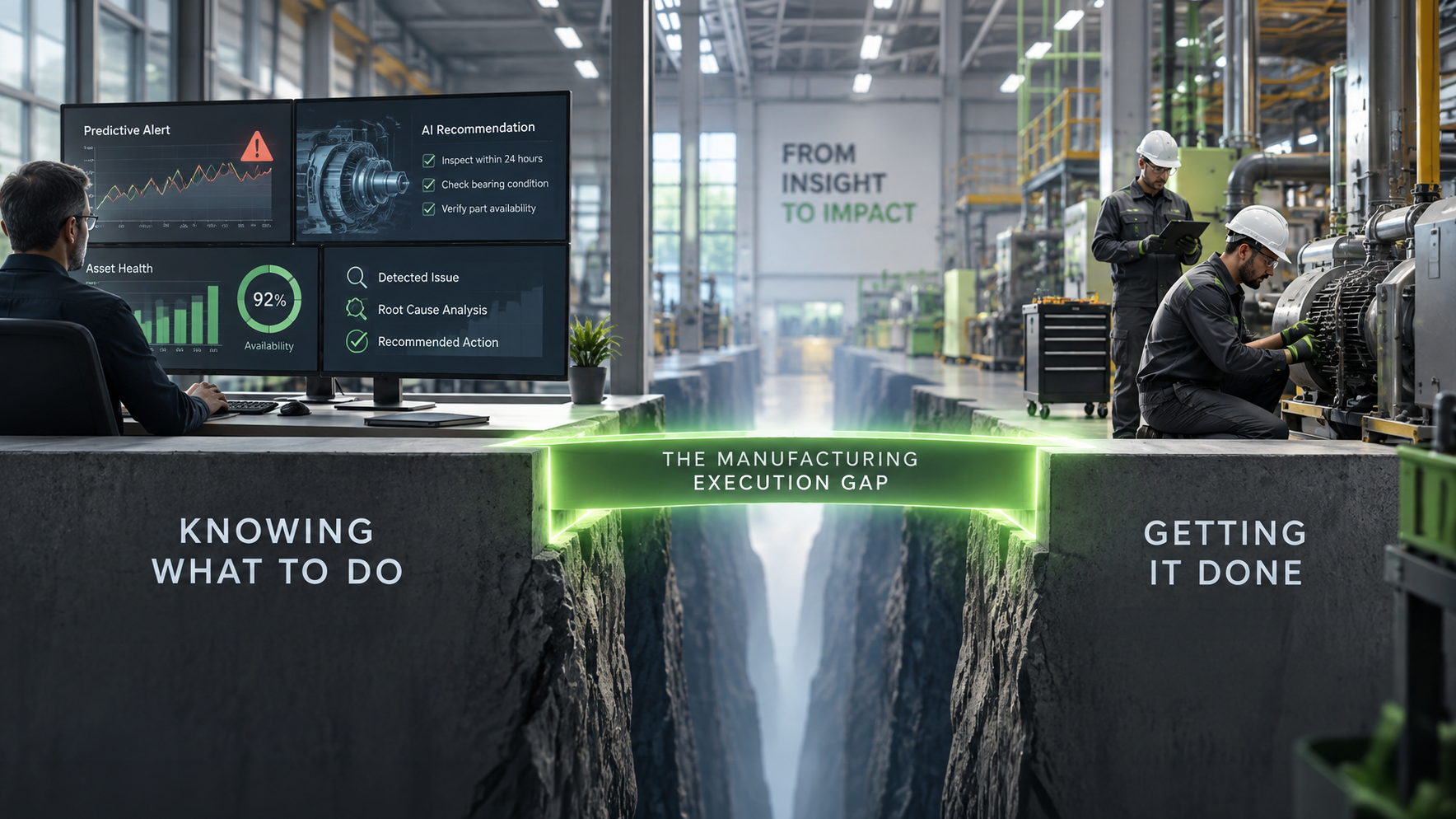
Manufacturers have spent decades investing in digitization, MES, analytics, IoT, dashboards, and now generative AI. Yet despite all this technology, many operational challenges remain fundamentally unchanged. Problems recur, decisions are delayed, and execution still depends heavily on manual coordination across plants, teams, and shifts.
Traditional manufacturing systems are designed primarily to provide insight. MES tracks operations, analytics explains trends, and generative AI improves access to information and accelerates decision support. Dashboards are the clearest example: they present data comprehensively and visually, but displaying information is not the same as acting on it. Seeing a deviation on a chart doesn’t fix the problem. Operational performance improves only when the right actions are consistently executed, tracked, and optimized over time.
This is where the next evolution of industrial AI is emerging: the AI-Powered System of Execution for Manufacturing.
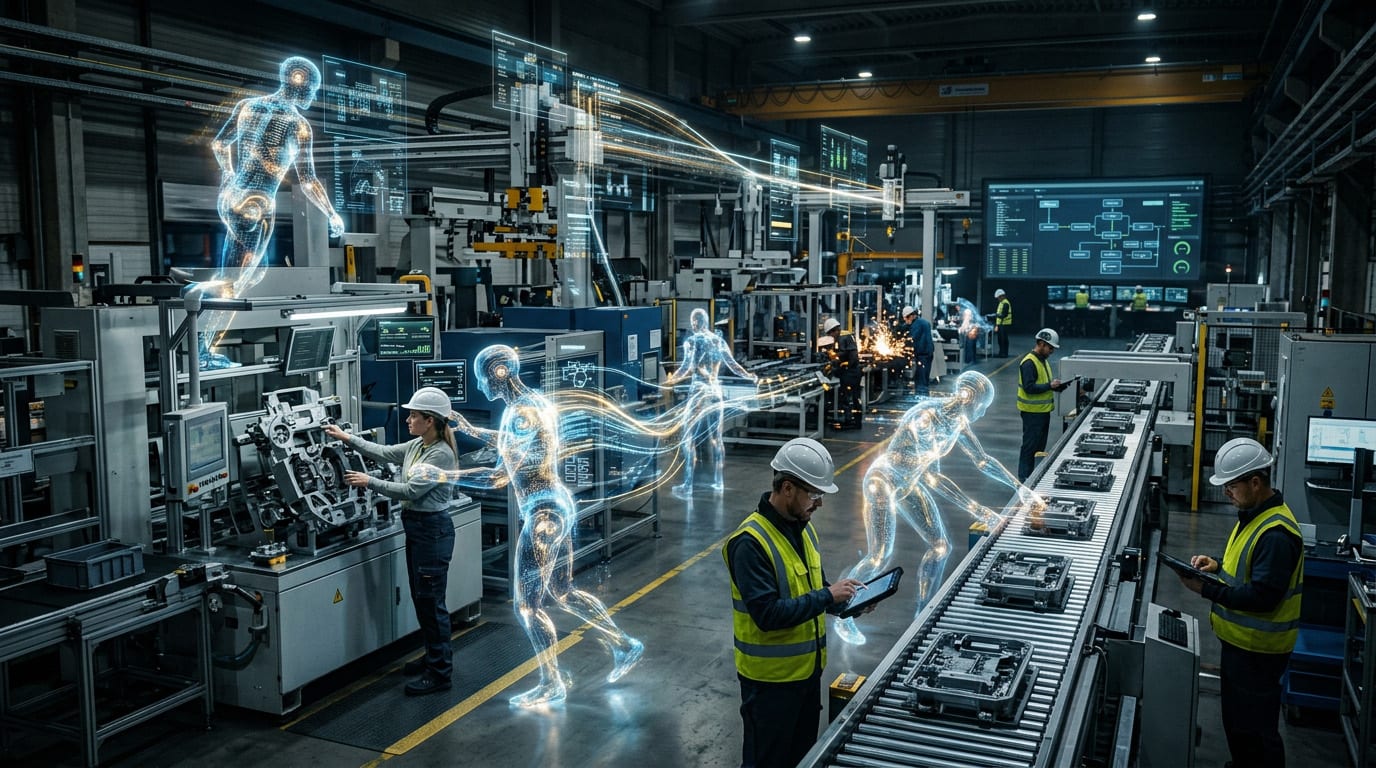
At the center of this new model is the AI Workforce : a coordinated system of intelligent AI agents that continuously monitor operations, identify issues, recommend actions, and support execution across the enterprise. Instead of simply helping manufacturers understand what happened, the AI Workforce helps ensure the right operational actions happen next.
The result is a closed operational loop:
- capture operational data in real time
- detect deviations and bottlenecks
- identify likely root causes
- recommend prioritized actions
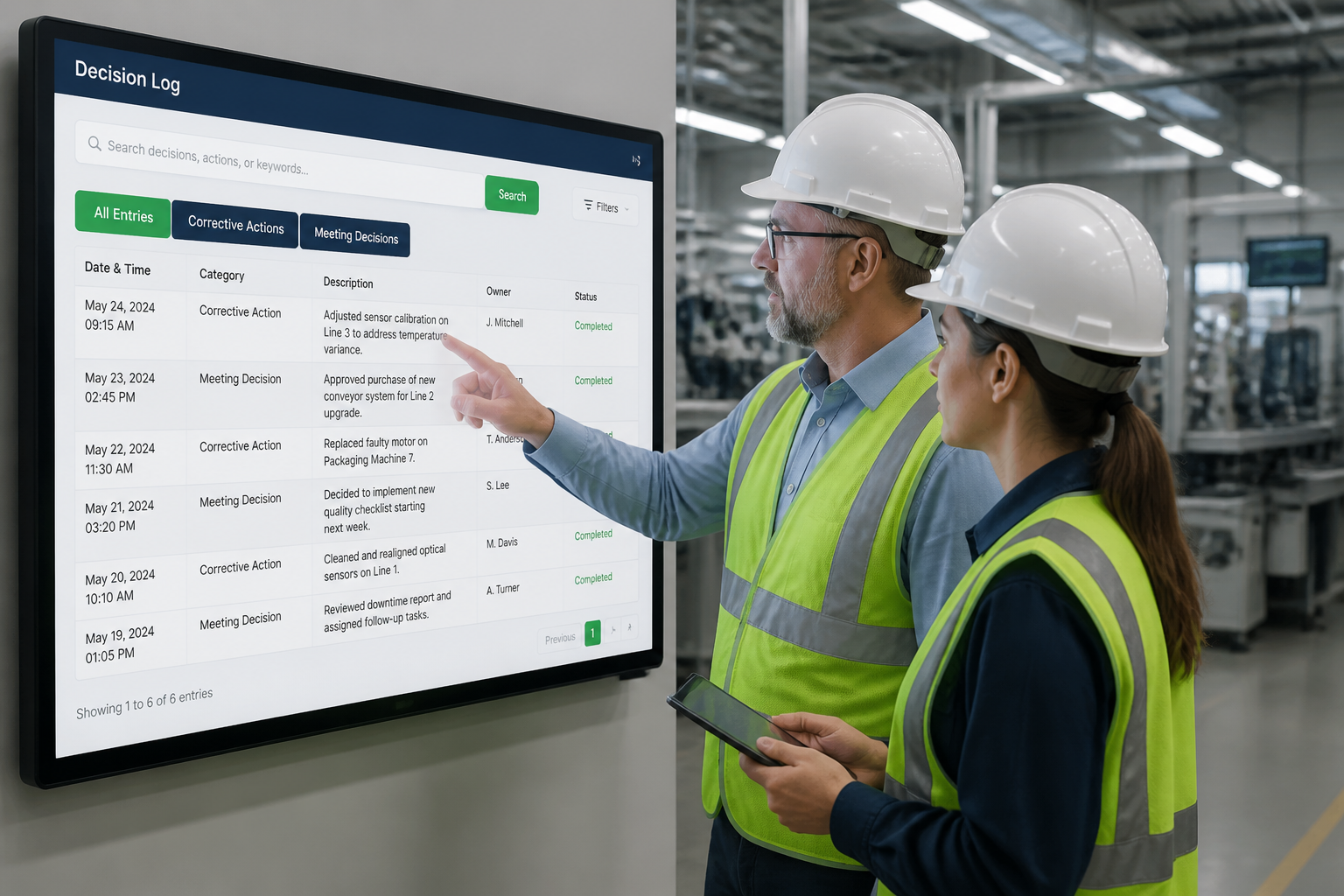
- track execution and accountability
- continuously reuse operational knowledge across the organization
The goal is not simply better insights. It is faster, more disciplined, and more scalable execution.
This represents a major shift in manufacturing operations. For years, manufacturers focused primarily on systems of record and systems of insight. The next competitive advantage will come from systems that coordinate and operationalize execution across plants, teams, and workflows. Decisyon is that execution layer. It is the bridge between the insights locked inside data and the actions that actually improve operations. Where dashboards and analytics stop at informing, Decisyon moves forward into doing.
Specialized AI agents play a central role in this transformation. Some improve shift handovers and operational continuity. Others accelerate root-cause analysis, identify production bottlenecks, optimize maintenance timing, strengthen compliance, or transform operational meetings into structured execution systems with accountability and follow-through.
Together, these agents create an intelligent execution layer that continuously improves operational performance.
Importantly, the AI Workforce is not designed to replace human judgment. Operators, engineers, supervisors, and managers remain in control. AI amplifies human capability by providing the speed, consistency, coordination, and scalability required to manage increasingly complex manufacturing environments.
The model is also highly practical. Organizations do not need to replace existing ERP, MES, SCADA, or IoT infrastructure. The AI-Powered System of Execution integrates with existing systems and can be deployed incrementally starting with a single workflow, production line, or plant before scaling across the enterprise.
Over the next decade, competitive advantage in manufacturing will not come from having more dashboards or more data. It will come from the ability to execute decisions faster, more consistently, and at scale.
That is the promise of the AI-Powered System of Execution: transforming manufacturing from reactive and fragmented operations into continuously improving systems where every decision, every action, and every outcome compounds over time.