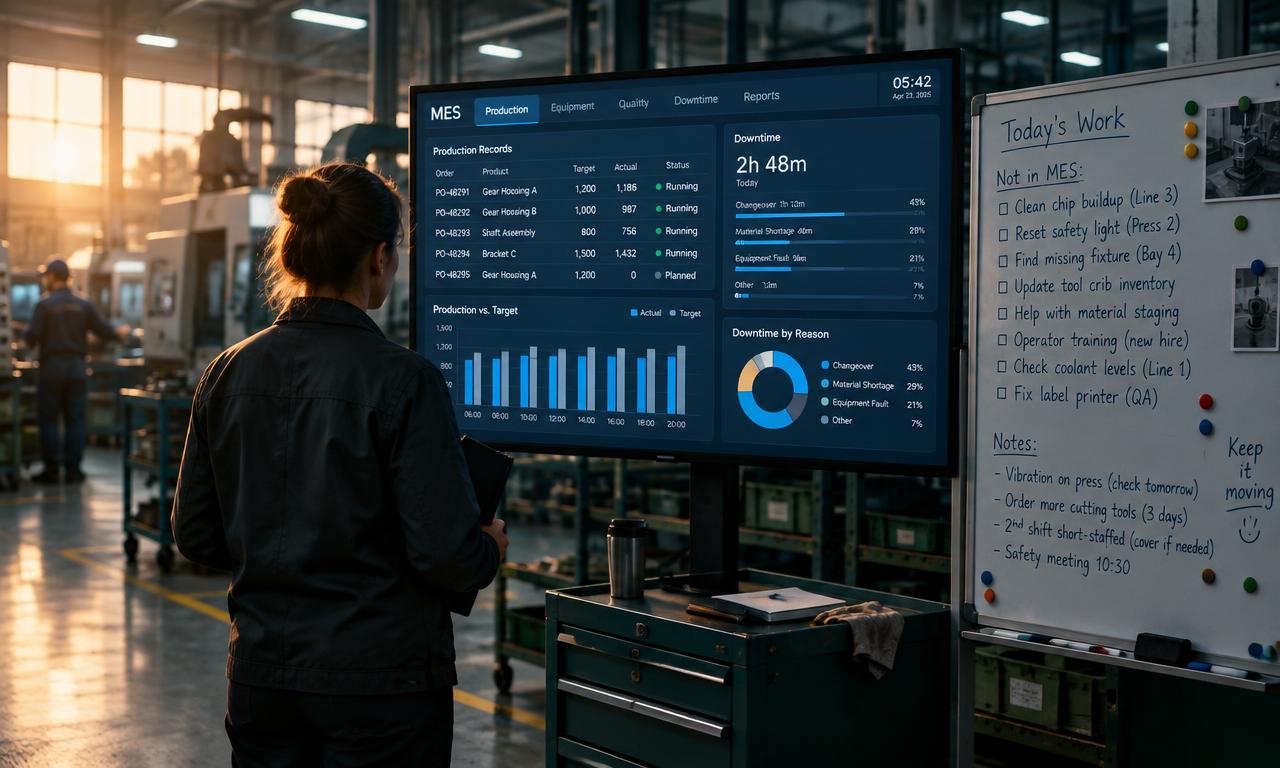

A daily management system is the routine that catches a problem on the shift it happens, gives it an owner before the meeting ends, and checks a week later whether the fix held. Most plants have the meeting and the board. What they are missing is the part after the meeting, where the action either gets done or quietly does not. Build the follow-through first and the boards start earning their wall space. See what the missed actions cost you in the ROI Report.
It is 6:55 a.m. at a packaging plant outside Greenville. Eleven people are standing at a whiteboard. The night shift supervisor reads out four problems. Someone writes them on the board in marker. Someone photographs the board. Everyone leaves.
By Thursday, two of the four are done. One is half done and nobody is sure by whom. The fourth shows up again the following Tuesday as a new problem, written by a different person, in the same handwriting-sized box on the same board.
That is not a meeting problem. The meeting worked. The system after the meeting does not exist.
What a daily management system is supposed to do
Strip away the lean vocabulary and it does four things.
It surfaces what changed since yesterday. It decides what to do about it. It puts a name and a date on each of those decisions. It comes back later and confirms whether the thing actually worked.
The first two happen in almost every plant already. The third happens on a whiteboard. The fourth almost never happens at all, which is why the same problem returns in a month wearing a different label.
Four things that break a daily management system
1. The data arrives too late to argue about. If the downtime numbers land at 10 a.m., the 7 a.m. meeting runs on memory. Memory rounds a twenty-minute stop down to fifteen and does not log the ninety-second one at all.
2. Actions live where nobody can see them. A whiteboard photo in a phone camera roll is not a task list. Neither is a spreadsheet on a shared drive that one person updates.
3. Ownership is ambient. "Maintenance will look at it" is not an owner. A name and a date is an owner.
4. Nobody checks whether the fix worked. Closing an action and fixing a problem are different events. If the system cannot show the line running better after the action closed, the plant is collecting completed tasks, not results.
How to build one, in the order that works
Start with one line and one meeting. Not the plant. One line, one shift-start review, fifteen minutes, five metrics people already argue about: safety, quality, delivery, cost, and the biggest loss since yesterday.
Get the numbers off the machines. Whatever the controller already knows — run state, cycle time, reject count — should be on the screen before the meeting starts. Typed-in numbers turn the review into a negotiation about the data instead of a decision about the line.
Write the action in the system, in the room. Owner, due date, the line it belongs to, the category it falls under. If it is written after the meeting, it is written in half the cases. Meeting Sense captures the action while the conversation happens and assigns it before anyone walks out, so the board and the task list stop disagreeing.
Escalate on the clock, not on someone noticing. An action that misses its date should raise itself to the next tier automatically. A supervisor should not have to be the escalation mechanism.
Verify against the number. Two weeks after a corrective action closes, the system should show the loss it was meant to remove. Meeting Insight reads the last several weeks of meetings, the actions taken, and the metrics that followed, and tells the plant which problems keep coming back regardless of how many actions got closed.
Then copy it. One line proves the routine. The second line takes a fraction of the time. Cross-plant is where the money is: Fix Finder searches corrective-action history across every connected plant and puts the fix that already worked somewhere else onto the tablet at the line tonight, instead of a team re-diagnosing a solved problem.
What it looks like when it holds
Schneider Electric runs this model across 218 plants with thousands of daily users and reports a 4 to 5% improvement in plant performance. Most of it comes from follow-through and from one site being able to see what another site already fixed. Read the full breakdown.
Abafoods put 150+ shop-floor users on one execution system and moved corrective actions from days to hours, with internal non-conformities falling alongside. Read the full breakdown.
Neither plant bought a better board. In both cases the action stopped depending on someone remembering it. Estimate what that is worth across your lines.
Whiteboard, spreadsheet, or system
| Whiteboard | Spreadsheet | Connected system | |
|---|---|---|---|
| Numbers available at meeting time | Manual | Manual | Live off the machines |
| Action has a named owner and date | Sometimes | Yes | Yes |
| Missed action escalates by itself | No | No | Yes |
| Fix verified against the metric | No | Rarely | Yes |
| Another plant can find the fix | No | No | Yes |
| Survives a supervisor leaving | No | No | Yes |
Most plants are in the first two columns. The move to the third usually shows up first as fewer repeat issues, not as a better score.
What to ignore, and three questions to ask
Ignore maturity-model posters, colour-coded board templates, and any demo that spends twenty minutes on chart configuration. None of that changes what happens on Thursday.
Ask three questions instead:
- Show me, live, what happens to an action that misses its due date at 2 a.m.
- Six months after go-live, who edits the categories and how long does it take?
- If this exact issue was solved at another plant last quarter, how does the operator on shift tonight find out?
If the answers are "someone follows up," "a consultant," and "they'd have to ask around," the daily management system is a meeting with better stationery.
Where Decisyon fits
LOOP is Decisyon's daily management application. It carries a problem from the shift-start review into an owned action, escalates it when it stalls, checks it against the number afterwards, and makes the result findable at the next plant. The agents that do the work inside it — Meeting Sense, Meeting Insight, and Fix Finder — are part of the Decisyon AI Workforce, and they run on data the plant already produces.
The plant feels it a quarter later as fewer repeats, shorter time from problem to fix, and a cost per unit that finally moves. See your number in the ROI Report → · Read the customer results →