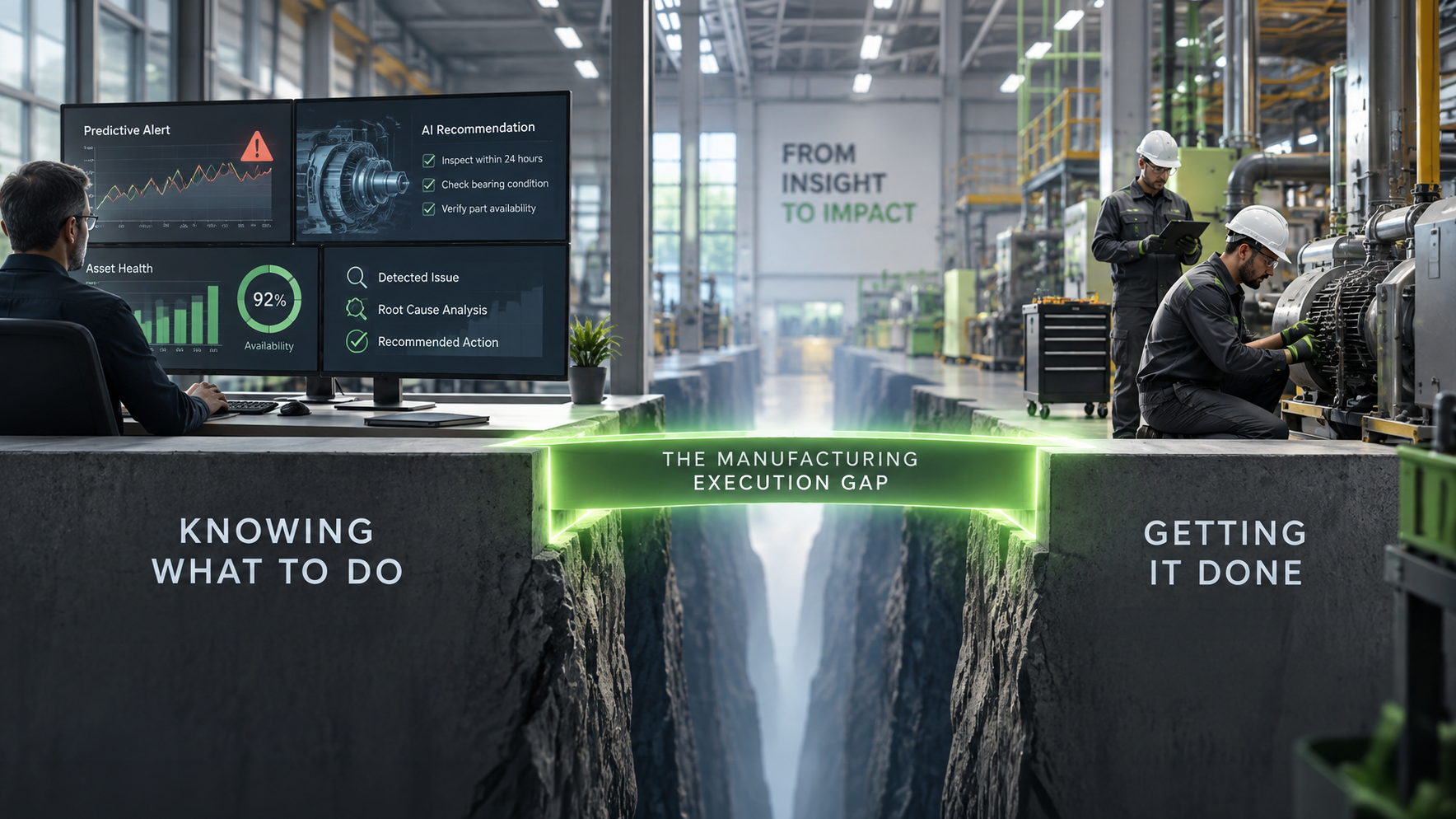
The APM vendors worth shortlisting in 2026 are the ones that ingest live signal from your existing PLCs, SCADA, and historians without custom middleware, run predictive models trained on industrial failure patterns, and close the loop into your CMMS or EAM automatically. Anything short of that is a dashboard, not an APM software vendor. This guide ranks the 11 platforms manufacturers actually evaluate — Decisyon, GE Digital, AVEVA, IBM Maximo, Hitachi, and the rest — on AI depth, integration approach, time-to-value, and who each fits. See what an hour of downtime is costing your plant before you shortlist.
Choosing the wrong APM vendor means 18 months of integration work, poor operator adoption, and no measurable plant-floor value. The right one moves you from Factory Data → Manufacturing Intelligence → Operational Execution → Operational Excellence — the value chain that separates a monitoring tool from an AI-Powered System of Execution. Whether you are evaluating your first APM deployment or replacing an underperforming system, this breakdown gives you a clear-eyed view of the market as it stands in 2026 — and models the payback before you commit to a vendor.
What APM software does
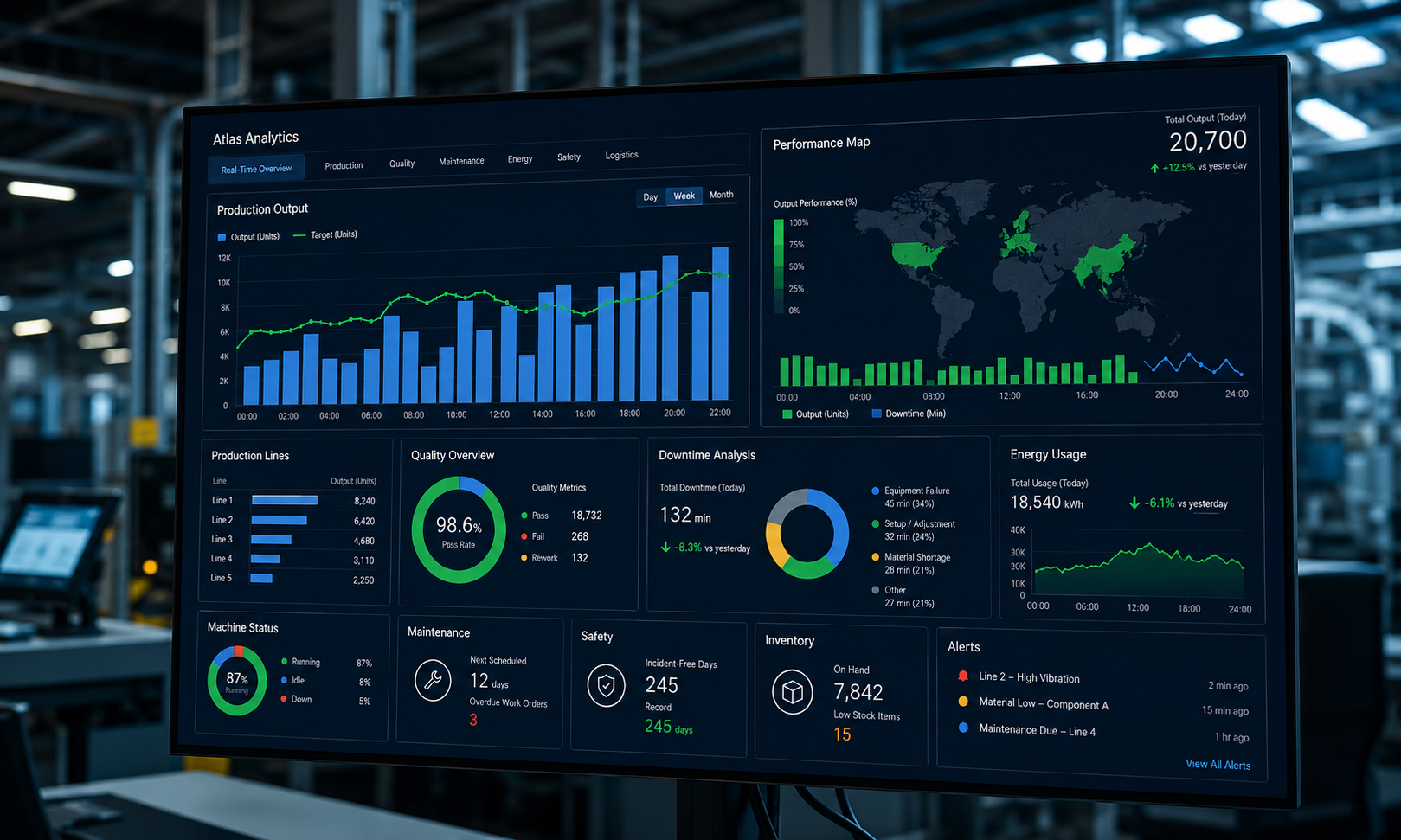
APM software (asset performance management software) reads live signal from PLCs, sensors and historians, scores the health of every asset, and flags the ones heading for failure while there is still time to act. It sits upstream of a CMMS: APM software decides what needs attention and why, the CMMS manages the work once it exists. A plant running APM software well stops finding out about a bearing from the noise it makes.
How to choose APM software: comparing APM vendors
Before diving into individual platforms, it helps to frame the evaluation criteria. Asset performance management has evolved considerably over the past decade. First-generation APM tools were essentially glorified maintenance schedulers. Modern platforms are expected to deliver predictive and prescriptive intelligence, pulling real-time signals from connected assets and surfacing recommended actions before failures cascade into downtime.
When evaluating vendors, plant managers and operations leaders should assess the following:
- Connectivity breadth: Can the platform connect to your existing PLCs, SCADA systems, historian databases, and EAM tools without custom middleware?
- AI and predictive depth: Does the system offer genuine machine learning models trained on industrial failure patterns, or is it rule-based monitoring dressed up as AI?
- Closed-loop execution: Can the platform not only detect an anomaly but automatically create a work order, assign a technician, and track resolution?
- Scalability across sites: Does performance hold when you roll out to 20 or 200 plants simultaneously?
- Time to value: How quickly can you go from kickoff to live monitoring? Vendors promising 18-month implementations are not competitive with platforms that deploy in weeks.
- Operator adoption: Sophisticated technology that operators do not use delivers no value. Evaluate the UX honestly.
With those criteria in mind, here is how the major APM software vendors compare.
Top Asset Performance Management Software Vendors in 2026
1. Decisyon APM — AI-Native, Closed-Loop Asset Intelligence
Decisyon’s Asset Performance Management solution is purpose-built for manufacturers who need more than passive monitoring. It delivers a unified view of asset health across machines, production lines, and multi-site networks, combining real-time data integration with predictive models that flag failure risk before downtime occurs.
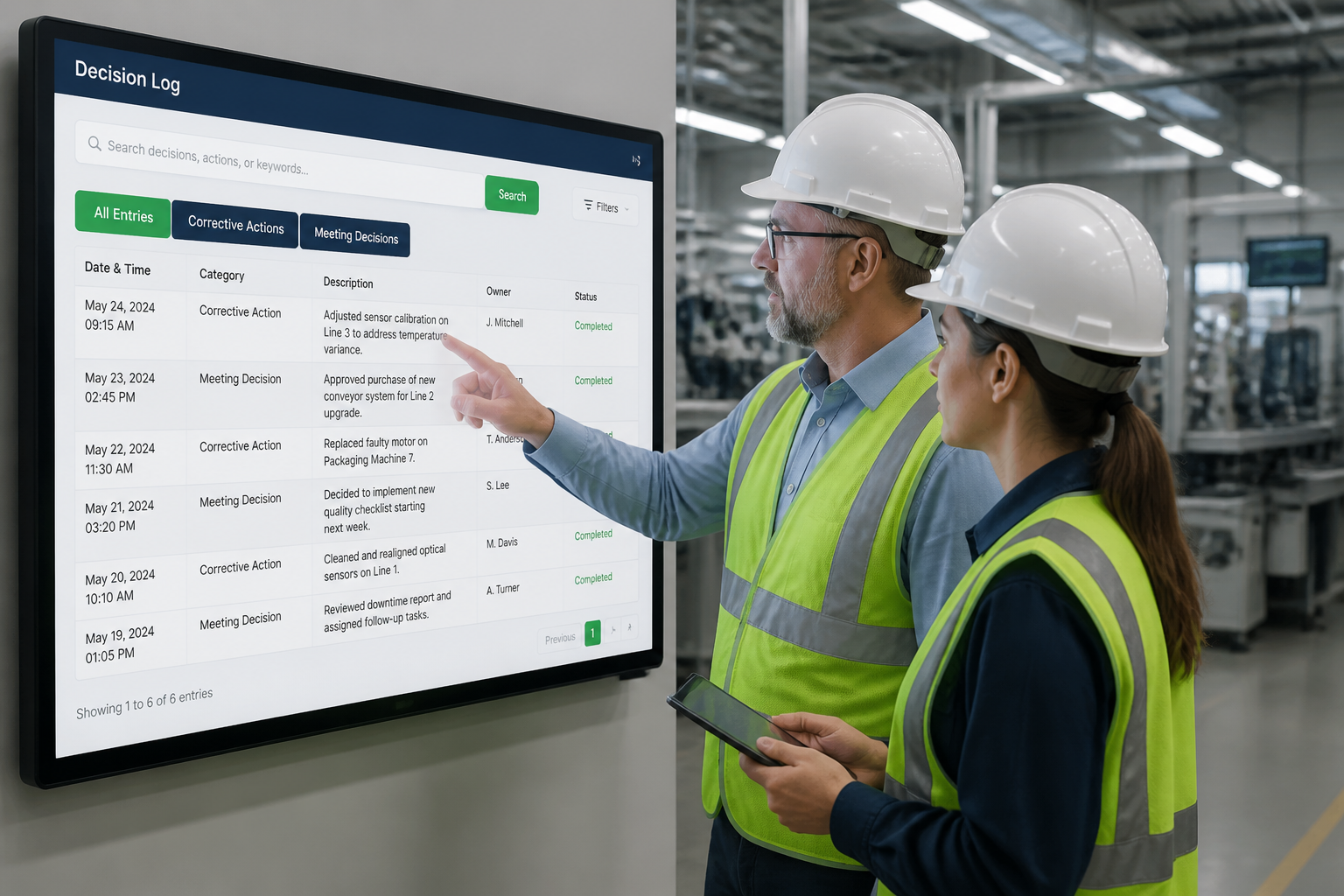
What separates Decisyon from most APM vendors is its agentic AI architecture. Rather than surfacing an alert and leaving the response to a maintenance planner, the platform’s AI agents do the next step. Fix Finder reads corrective-action history across every connected plant and routes the proven fix to the technician standing at the asset. Deep Find pulls the manual page, the past work order and the engineering note behind that fault so nobody rebuilds the diagnosis from scratch. The result is a closed-loop system: detect an anomaly, identify the cause, assign the task, and confirm resolution within a single workflow.
Key performance results documented across customer deployments include:
- Up to 20% reduction in unplanned downtime
- 15-20% improvement in labor utilization
- 5% gain in overall asset utilization
- 300% ROI in many deployments, typically achieved within six months
Decisyon APM integrates natively with historian systems, existing EAM platforms, ERP systems, and IoT data streams through the Decisyon Smart Gateway, eliminating the data silo problem that undermines most first-generation APM deployments. The platform also supports low-code configuration, meaning maintenance leaders can adapt dashboards, alerts, and workflows without relying on IT or consulting resources.
Best for: Global manufacturers in CPG, Food and Beverage, Pharmaceutical, and Industrial sectors looking for rapid deployment, closed-loop AI execution, and proven ROI at scale.
Deployment: SaaS and on-premise. Scales from single plant to 250+ sites.
2. IBM Maximo Application Suite
IBM Maximo is one of the most established names in enterprise asset management and has expanded its capability set over the years to include APM functionality through the Maximo Application Suite. It offers strong integration with IBM’s broader AI and analytics portfolio, including Watson-based predictive models for failure probability scoring.
Maximo’s depth is a double-edged sword. For large enterprises already invested in IBM infrastructure, the platform offers broad integration potential. For manufacturers evaluating a standalone APM deployment, Maximo’s complexity and long implementation cycles are significant headwinds. Deployments often require 12-18 months and substantial consulting resources before meaningful value is realized.
The platform’s strengths lie in regulated industries where auditability and compliance documentation requirements are high. Its weakness is agility: adapting Maximo to new workflows or connecting new asset types requires significant configuration effort and IT involvement.
Best for: Large enterprises with existing IBM infrastructure and the internal resources to manage a complex implementation.
Deployment: Cloud and on-premise. Implementation timeline typically 12-18 months.
3. GE Digital APM (Predix)
GE Digital’s APM platform, built on the Predix infrastructure, has historically targeted heavy asset industries including power generation, oil and gas, and utilities. The platform offers strong reliability-centered maintenance (RCM) methodology support and established frameworks for consequence-driven risk prioritization.
GE Digital’s APM provides pre-built failure mode libraries and risk matrices that experienced reliability engineers appreciate. However, manufacturers in fast-moving sectors like Consumer Packaged Goods or Food and Beverage often find the platform’s asset risk framework oriented more toward capital-intensive, low-frequency failure scenarios than the high-volume, multi-line complexity common in their operations.
Integration outside of GE’s own equipment ecosystem can require additional middleware, and the platform’s learning curve has been cited as a barrier to broad operator adoption in plant environments where teams span multiple shifts and skill levels.
Best for: Heavy asset industries (power, oil and gas, utilities) with dedicated reliability engineering teams and GE equipment infrastructure.
Deployment: Cloud-based (Predix). Implementation complexity varies by existing GE ecosystem integration.
4. Uptake
Uptake entered the industrial AI market focused on predictive analytics for asset-intensive industries. Its platform applies machine learning to equipment sensor data to identify anomalies and predict remaining useful life for industrial assets. The company’s strength is in its data science capability and pre-trained models for specific asset types in mining, rail, and industrial manufacturing.
Where Uptake tends to fall short for manufacturers is in the “last mile” of APM value — workflow integration and closed-loop action. The platform surfaces predictions effectively but requires connection to separate CMMS or EAM systems for work order creation and maintenance tracking. For manufacturers looking for a vertically integrated APM experience, this gap can mean significant integration effort.
Uptake’s model approach is also more custom-development-intensive, which affects time to value for manufacturers without dedicated data science resources in-house.
Best for: Organizations with in-house data science teams and specific high-value assets where predictive model depth outweighs the need for integrated workflow execution.
Deployment: Cloud-native. Implementation timeline depends heavily on model training data availability.
5. Senseye (Acquired by Siemens)
Senseye Predictive Maintenance, now part of the Siemens ecosystem following its acquisition, offers an asset health monitoring platform that uses machine data and AI to calculate health scores and predict time-to-failure for industrial equipment. The platform’s core value proposition is ease of connection — it requires minimal configuration to start generating asset health signals from existing sensor infrastructure.
Post-acquisition, Senseye is increasingly positioned as a component within Siemens’ broader digital manufacturing stack, which includes Opcenter and the Xcelerator portfolio. For manufacturers already standardized on Siemens industrial automation and software, the integrated path is logical. For those running a mixed environment, the Siemens ecosystem dependency creates vendor lock-in risk.
Senseye’s predictive capability is solid for standard machinery health monitoring but is less differentiated in terms of prescriptive action and cross-plant intelligence compared to newer AI-native platforms.
Best for: Siemens-ecosystem manufacturers looking for predictive maintenance as an extension of their existing Opcenter or automation investments.
Deployment: Cloud (SaaS). Natively integrated within Siemens Xcelerator. Implementation faster when Siemens infrastructure is already in place.
6. SAP Plant Maintenance / SAP APM
SAP’s asset management offering has evolved from its core Plant Maintenance (PM) module toward a more complete APM capability. For organizations running SAP ERP, the appeal is obvious: maintenance data, procurement, financials, and production planning all live within a connected ecosystem. SAP’s predictive asset insights capability uses real-time equipment data to generate maintenance recommendations surfaced within the familiar SAP environment.
The challenge with SAP APM is consistent across most SAP deployments: implementation cost and complexity are high, and the platform is most valuable for organizations with significant existing SAP maturity. Manufacturers without a strong SAP foundation should expect substantial investment before APM functionality delivers meaningful operational outcomes.
SAP is also less competitive on speed of deployment. For manufacturers who need to move from kickoff to live monitoring in weeks rather than quarters, the SAP pathway is rarely the fastest route.
Best for: SAP-standardized enterprises seeking to extend their existing ERP investment into predictive maintenance without introducing a separate system.
Deployment: Cloud (SAP BTP) and on-premise. Implementation typically 6-18 months depending on existing SAP maturity.
7. AspenTech APM
AspenTech’s APM offering is oriented primarily toward process industries — petrochemical, refining, and specialty chemicals — where continuous process optimization and equipment reliability are tightly linked. The platform provides strong integration with process simulation tools and offers reliability and integrity management capabilities suited to high-hazard environments.
For discrete manufacturers outside process industries, AspenTech’s value proposition is less directly applicable. The platform’s depth in process engineering workflows does not translate as naturally to the multi-line, multi-SKU complexity common in Consumer Packaged Goods or Food and Beverage manufacturing.
Best for: Process industries (chemicals, refining, petrochemicals) where equipment reliability and process optimization are interconnected.
Deployment: Cloud and on-premise. Primarily targeted at process manufacturing sectors.
How Do These APM Vendors Compare on Key Criteria?
| Vendor | AI Depth | Closed-Loop Action | Multi-Site Scale | Deployment Speed | Best Industry Fit |
|---|---|---|---|---|---|
| Decisyon APM | Agentic AI with prescriptive recommendations | Yes — automated work orders and follow-up | 250+ plants on single platform | Weeks | CPG, F&B, Pharma, Industrial |
| IBM Maximo | Watson-based predictive scoring | Partial — requires EAM workflow setup | Strong enterprise scale | 12-18 months | Regulated industries, IBM-standardized enterprises |
| GE Digital APM | RCM-based risk frameworks + ML | Partial | Moderate | Moderate to long | Power, oil and gas, utilities |
| Uptake | Custom ML models for specific assets | No — requires separate CMMS integration | Moderate | Depends on model training | Mining, rail, industrial (data science heavy) |
| Senseye (Siemens) | Health scoring and time-to-failure prediction | Partial (within Siemens stack) | Good within Siemens ecosystem | Fast (Siemens environments) | Siemens automation customers |
| SAP APM | Predictive asset insights within ERP | Yes (within SAP ERP) | Strong (SAP environments) | 6-18 months | SAP-standardized enterprises |
| AspenTech APM | Process reliability and integrity management | Partial | Moderate | Moderate | Process industries (chemicals, refining) |
What Makes the Right APM Software Vendor for Manufacturing?
The vendors above represent a spectrum from broad enterprise platforms to specialized predictive tools. For manufacturers evaluating this space, a few patterns become clear:
Generic enterprise platforms (SAP, IBM Maximo) offer integration depth but sacrifice speed and agility. If your operation is already standardized on one of these ecosystems and you have the internal resources to manage a complex deployment, these platforms make sense. If you are a mid-market manufacturer or a global enterprise looking to move quickly, the implementation timelines and consulting costs are significant barriers.
Specialized predictive tools (Uptake, Senseye) offer strong detection capability but incomplete execution. Knowing a bearing is likely to fail in 72 hours is valuable. Having the platform automatically route a work order, locate the right technician on shift, and confirm the repair was completed closes the loop. Tools that stop at prediction leave the hardest part of APM — driving action and accountability — to human coordination.
AI-native, closed-loop platforms represent the emerging standard. The most effective APM deployments combine real-time connectivity, predictive intelligence, and automated action workflows within a single integrated environment. This approach eliminates the latency between detection and response that defines reactive maintenance cultures.
Manufacturers who want to understand what this looks like in practice — and what ROI is realistic for their asset footprint — can use Decisyon's AI asset performance management solutions framework to evaluate their current baseline and target improvements. For the reverse view — what waiting another quarter on APM actually costs — the business case is usually the deciding factor with finance.
The Role of Predictive AI in Modern APM Platforms
The distinction between “predictive maintenance” as a marketing claim and genuine predictive AI capability is increasingly important as manufacturers select vendors. Several factors separate authentic predictive intelligence from rule-based alert systems dressed up with AI language:
Model training on industrial failure patterns: Effective predictive APM models require training on historical failure data that reflects the specific failure modes relevant to manufacturing equipment. Generic ML models applied to industrial sensor data without domain-specific training produce high rates of false positives that erode operator trust.
Multi-variable anomaly detection: Real equipment failures rarely appear as a single sensor crossing a threshold. Effective AI-driven APM correlates signals across multiple sensors and operational parameters to identify failure signatures before any individual metric triggers a traditional alarm.
Prescriptive recommendations: Predictive models that output “this asset has a 78% probability of failure in the next 14 days” are useful but incomplete. The operational value multiplies when the system recommends specific maintenance actions based on the predicted failure mode, available parts inventory, and technician schedules.
For a deeper look at how AI is transforming predictive maintenance in manufacturing, see the Decisyon perspective on AI for predictive asset maintenance and the documented benefits of AI predictive maintenance across industrial environments.
Common Questions from Manufacturing Leaders Evaluating APM Software
How long does it take to see ROI from an APM software deployment?
The answer depends significantly on which vendor and deployment approach you choose. AI-native platforms like Decisyon that deploy in weeks and connect to existing asset infrastructure can deliver measurable OEE improvements and downtime reductions within the first 90 days. Traditional enterprise APM platforms with 12-18 month implementation cycles push the ROI timeline well into the second or third year of the project. For most manufacturers, the faster path to value is a purpose-built industrial APM platform rather than an extension of a broader enterprise software suite.
What is the difference between APM and predictive maintenance?
Predictive maintenance is a component of asset performance management, not a synonym for it. Predictive maintenance focuses specifically on forecasting equipment failures before they occur. APM is a broader discipline that encompasses asset health monitoring, reliability planning, maintenance workflow execution, failure mode analysis, and performance benchmarking across the asset portfolio. The best APM software vendors combine predictive maintenance capability with the full operational workflow needed to act on predictions efficiently.
Can APM software integrate with my existing ERP or CMMS?
Yes, but integration depth varies significantly across vendors. Some platforms require custom middleware or professional services to connect to standard ERP systems like SAP or Oracle. Others, like Decisyon, offer native IT/OT integration that connects to historian systems, EAM platforms, ERP environments, and IoT sensor networks without significant custom development. Always ask prospective vendors for specific, documented integration case studies with your existing systems before committing to a platform.
How many plants can APM software scale to simultaneously?
This is a frequently underestimated question in vendor evaluations. Some platforms perform well in single-site pilots but degrade in performance or increase dramatically in cost when rolled out across 20 or 50 plants. Decisyon has documented deployments at 250+ plants simultaneously, including 70,000+ concurrent users at a single customer. If your organization manages multiple manufacturing sites, validate the vendor’s multi-site track record with reference customers at comparable scale.
Choosing the Right APM Vendor for Your Operation
The asset performance management software market has matured significantly. The vendors covered in this guide represent different philosophies about where the value in APM lies: in broad enterprise integration, in deep predictive science, or in rapid deployment with closed-loop AI execution.
For global manufacturers looking to move from reactive to proactive operations quickly, the case for AI-native platforms is compelling. The ability to connect existing assets, deploy within weeks, and demonstrate measurable downtime reduction before the end of the first quarter is a fundamentally different value proposition than legacy APM implementations that spend the first year in integration work.
For manufacturers in the early stages of evaluating APM software vendors, the most productive next step is understanding what ROI is realistic for your specific operation, asset mix, and current maintenance maturity level.
If you are still settling the basics of the discipline before comparing products, start with what asset performance management actually is. If the buying question is really about lost minutes on a line rather than asset health, the OEE monitoring software buyer's guide is the closer match. If you already know what you need, the ROI Advisor generates a customized analysis based on your plant count, production volume, and current OEE baseline — a grounded financial case to bring to internal stakeholders before you finalize vendor selection.