The conversation around AI is loud, but on the factory floor, hype doesn’t improve throughput. Performance does. The real transformation isn’t coming from a standalone chatbot; it’s happening quietly, inside the operational systems you rely on every day. When AI is woven directly into your production and maintenance workflows, it stops being a novelty and starts driving results. This is the core of embedded AI improvement: making your existing processes smarter and more consistent. We’ll show you how this practical approach works, from reducing downtime to strengthening your bottom line.
Will generative AI hollow out enterprise software? In manufacturing, the answer is clear: no.
AI is not replacing operational platforms. It is amplifying and accelerating them. The systems that already manage mission-critical workflows, data, and decisions are becoming more powerful, not less relevant.
The real transformation is not AI as a standalone tool. It is AI embedded directly into your operational systems, where accountability, performance, and financial impact already live.
Putting Your Industrial Data to Work
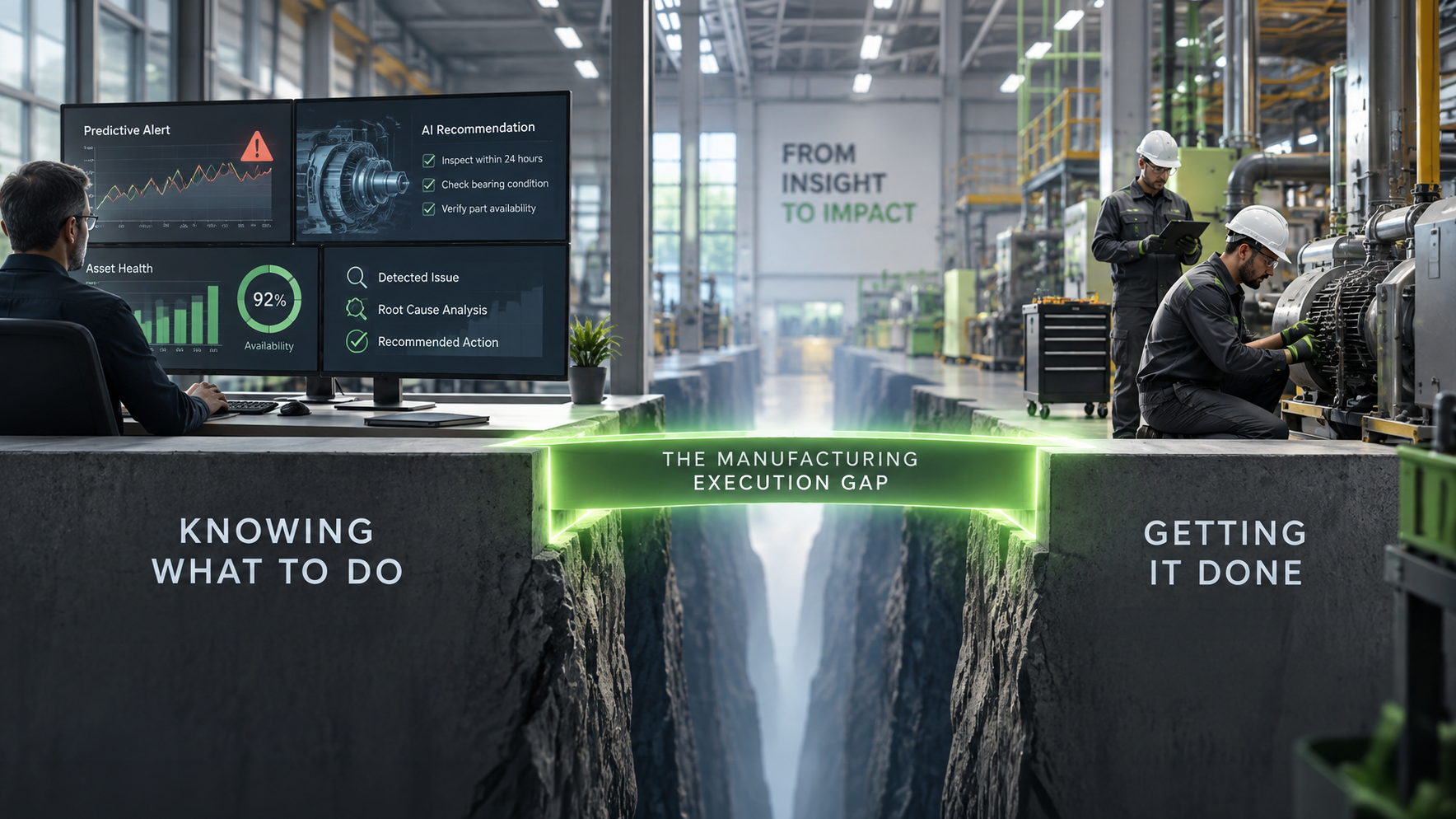
Manufacturing has never lacked data. What it lacks is contextual, timely intelligence.
Telemetry, quality metrics, maintenance logs, compliance records, and production workflows already exist in abundance. The constraint is not information but rather it is decision speed and consistency.
When AI is embedded inside an operational platform:
- Patterns surface earlier
- Anomalies are detected in real time
- Root causes are contextualized automatically
- Recommendations become prescriptive
- Impact is quantified financially
Generative AI adds another layer: natural-language summaries, conversational KPI analysis, and executive-ready insights in seconds.
But the durable advantage is compounding intelligence. AI embedded in live workflows improves continuously as it interacts with real operational context. That feedback loop compounds value month after month over the lifetime of the system.
This is the difference between experimenting with AI and operationalizing it.
How Embedded AI Turns Insights into Action
Insight without execution is noise.
The next evolution is AI Agents operating directly inside production, maintenance, quality, and continuous improvement workflows not as chat interfaces, but as governed operational participants.
Embedded AI Agents can:
- Generate structured corrective action plans
- Recommend optimized production sequences
- Draft shift and compliance reports
- Propose preventive maintenance schedules
- Trigger workflow escalations automatically
These agents operate within enterprise guardrails aligned with KPIs, governance models, and regulatory constraints.
The measurable impact:
- Faster decision cycles
- Reduced coordination friction
- Higher operational consistency
- Lower cognitive load on teams
- Direct financial improvement in throughput, OEE, downtime, and quality
AI does not replace plant personnel. It reduces ambiguity and accelerates execution, translating operational performance and financial outcomes.
So, Where Does the ROI Come From?
Manufacturers do not invest in AI for novelty. They invest for performance.
Embedded AI improves the four core drivers of operational cash generation:
- Downtime Reduction: AI-enhanced predictive and prescriptive maintenance reduces unplanned stoppages.
- Throughput Improvement: Optimized scheduling and faster issue resolution increase units produced per shift.
- Quality Yield: Earlier anomaly detection reduces scrap, rework, and compliance risk.
- Labor Productivity: Automated reporting, analysis, and coordination reduce manual overhead.
When these drivers improve by even small percentages, the cash impact compounds quickly, often far exceeding the cost of the system itself. That is where ROI originates.
ROI does not come from “having AI.” It comes from wiring AI into the decisions that govern downtime, throughput, yield, and labor so that every production day generates more value than the last.
Why the Right Infrastructure Makes All the Difference
AI without scalable infrastructure is experimentation.
AI embedded in secure, multi-tenant SaaS delivered on AWS becomes enterprise-ready.
Modern manufacturing platforms must provide:
- Elastic compute for AI workloads
- Enterprise-grade identity and governance
- Global deployment across plants
- Rapid provisioning for frictionless pilots
Time-to-value compresses from quarters to weeks. Deployment risk decreases. ROI becomes more predictable. AI must be deployable, secure, and scalable; otherwise, its theoretical potential never becomes an operational reality.
Why Context Is Your Competitive Edge
Large AI models are generalists. Manufacturing is not.
Improving OEE in a regulated pharma plant differs from optimizing yield in discrete manufacturing. Physical constraints, compliance frameworks, and governance structures matter.
AI creates a durable advantage only when grounded in:
- Real operational KPIs
- Tiered governance models
- Regulatory constraints
- Asset-level context
AI without domain depth looks impressive. AI grounded in operational reality is transformative.
Measuring What Matters: Performance Over Hype
Manufacturers evaluate AI the same way they evaluate any capital project: by its effect on throughput, cost, risk, and working capital.
Narrative matters far less than performance.
The solutions that will lead the market are those that make AI part of the operational backbone: embedded in production workflows, aligned with plant KPIs, and governed so decisions remain transparent and auditable.
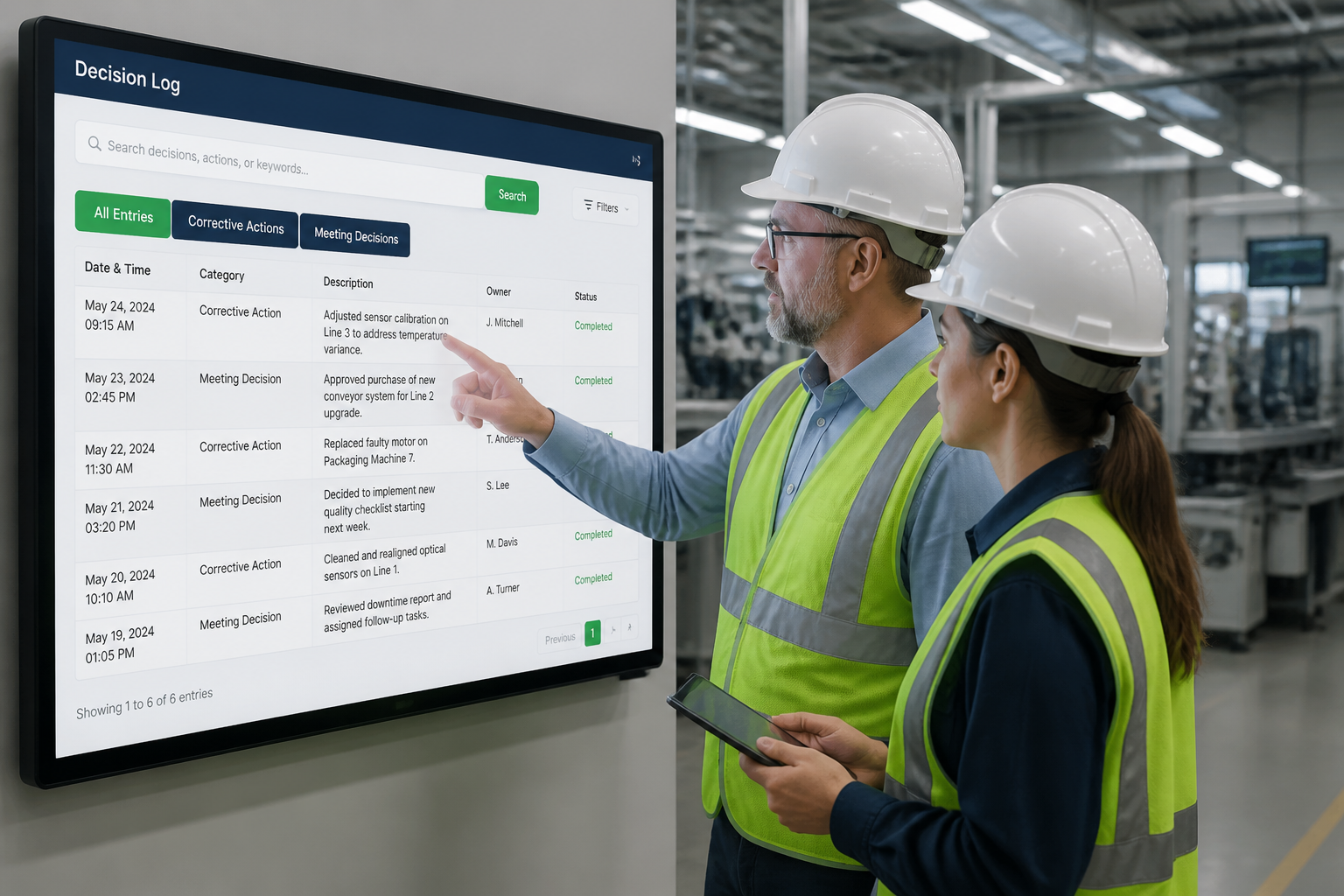
When AI shows up reliably in daily tier meetings, performance reviews, and financial results, it earns a permanent role in the operating model.
At Decisyon, we are:
- Embedding AI Agents in core operational applications where they can influence real-world actions and outcomes.
- Delivering AI-native SaaS on AWS to provide secure, scalable infrastructure across plants and regions.
- Structuring pilots to prove value quickly, then scale without architectural redesign.
- Targeting measurable improvements in throughput, OEE, downtime, quality, and working capital efficiency.
For manufacturers, the practical question is simple:
Does an AI-enabled platform help them run more secure, efficient, and predictable operations at scale?
When the answer is yes, when throughput improves, downtime falls, quality stabilizes, and cash flow strengthens, the business case stands on its own and no hype required.
Facing the Real-World Challenges of Embedded AI
While the potential of embedded AI is immense, the path to implementation is filled with practical hurdles that generic AI models are not equipped to handle. The factory floor is a complex environment where digital instructions meet physical reality, and this intersection is where many AI initiatives stumble. Unlike pure software applications, manufacturing involves specific, often proprietary, hardware and high-stakes processes where errors can be costly. Successfully deploying AI requires moving beyond theoretical capabilities and confronting the messy, tangible challenges of the industrial world, from hardware compatibility to the reliability of the AI’s own outputs.
The Hardware Hurdle: When AI Meets Physical Systems
One of the most significant challenges is that AI often struggles with the specifics of physical equipment. As one developer noted, “AI has a hard time with specific hardware details, like how different parts of a chip work, exact timing, and tools made by specific companies.” This is a critical issue in manufacturing, where operations depend on a diverse ecosystem of PLCs, sensors, and machinery, each with its own protocols and constraints. An AI model that doesn’t understand the difference between two controller models can generate code or suggest parameters that are not just ineffective but potentially damaging. This is why a robust integration layer that can translate between the AI’s intelligence and the plant’s physical assets is absolutely essential for success.
Navigating AI “Hallucinations” and Inaccuracies
Beyond hardware incompatibility, there is the risk of AI “hallucinations,” where the model generates plausible but incorrect information. In a manufacturing context, this can be dangerous. For instance, an AI might “invent fake hardware parts or settings that don’t exist, leading to code that won’t work.” Imagine a maintenance recommendation that references a non-existent valve or a process adjustment based on a phantom sensor reading. These inaccuracies can bring production to a halt and erode trust in the system. To be effective, embedded AI must be grounded in the specific reality of your factory, operating with strict guardrails and validation checks to ensure its outputs are not just intelligent, but also factually correct and actionable.
The Human Factor: How AI Influences Your Team
Implementing AI on the factory floor is as much a human challenge as it is a technical one. The goal is not to replace skilled operators but to augment their abilities, turning data into clear, actionable insights that make their jobs easier and more effective. This requires a thoughtful approach to system design, focusing on building a partnership between people and technology. When AI is introduced as a collaborative tool rather than a black-box authority, it fosters trust and encourages adoption. It also requires an awareness of how these tools change the way people think and work, ensuring that technology empowers your team without inadvertently creating new cognitive burdens or skill gaps.
Designing for Partnership, Not Just Prediction
For your team to trust an AI system, they need to understand how it arrives at its conclusions. A system that simply spits out predictions without explanation will always be met with skepticism. According to researchers at Carnegie Mellon University, “AI should clearly show how it finds information and if it can truly help.” This transparency is the foundation of a true human-AI partnership. When an AI recommends adjusting a production line, it should also present the key data points and logic behind that recommendation. This allows an experienced operator to validate the insight, combine it with their own expertise, and make a confident, informed decision, fostering a culture of collaboration rather than blind compliance.
Addressing Cognitive Debt on the Factory Floor
As we rely more on technology to handle tasks, we risk creating “cognitive debt.” When we offload thinking to a machine, our own problem-solving muscles can weaken. As one study points out, “Relying on AI for tasks means our brains don’t work as hard, which can make us remember things less effectively.” The solution is not to reject AI but to use it strategically. By automating routine data analysis and reporting, AI can free up your team’s mental bandwidth for higher-value activities like process innovation, strategic planning, and complex problem-solving. The goal is to use AI to handle the noise, allowing your people to focus on what they do best: thinking critically and driving continuous improvement.
The Broader Landscape of Embedded AI
To realize the full value of embedded AI, it’s important to look beyond individual use cases and consider the broader operational landscape. Successful AI implementation is not about isolated experiments; it’s about weaving intelligence into the very fabric of your manufacturing operations. This means connecting AI-driven insights directly to core business objectives and ensuring that the technology is transparent and trustworthy for everyone who uses it. When AI is treated as an integral part of the operational system, grounded in business reality and designed for human collaboration, it becomes a sustainable source of competitive advantage rather than just a fleeting technological novelty.
Beyond the Factory Floor
The most effective AI strategies are those that are directly linked to financial and operational outcomes. As we believe at Decisyon, “AI creates a durable advantage only when grounded in real operational KPIs.” An AI model that can predict machine failure is interesting, but an AI model that can predict failure *and* quantify the financial impact of the potential downtime is transformative. By connecting AI insights to key metrics like OEE, throughput, and cost per unit, you can prioritize actions that deliver the greatest business value. This ensures that your AI initiatives are not just technically impressive but are actively contributing to the bottom line, making the ROI clear to everyone from the plant manager to the CFO.
The Critical Need for Explainable AI (XAI)
In high-stakes environments like manufacturing, “because the AI said so” is not an acceptable answer. This is where Explainable AI (XAI) becomes essential. The goal of XAI is to develop “tools to help people understand how AI systems make decisions, so humans and AI can work together better.” Instead of a black box, an explainable system provides clear, human-understandable reasons for its recommendations. This is crucial for troubleshooting, compliance audits, and continuous improvement. When your team can understand *why* the AI is suggesting a certain action, they can trust the recommendation, learn from the insight, and maintain ultimate control over the operation.
Understanding the True Cost and Efficiency of AI
While AI promises to unlock new levels of efficiency, the technology itself is not without cost. The computational power required to train and run sophisticated AI models can be substantial, consuming significant energy and financial resources. A pragmatic approach to AI involves weighing the expected benefits against these real-world costs. This means being selective about where and how you deploy AI, focusing on applications that deliver a clear return on investment. Rather than chasing the largest, most powerful models for every task, smart manufacturers are adopting a more targeted approach, using efficient, purpose-built AI that solves specific problems without excessive overhead.
AI’s Energy Consumption and the Efficiency Paradox
The energy required to power AI can be staggering. Researchers at Carnegie Mellon University highlighted this by noting that “training ChatGPT used a huge amount of energy (50 gigawatt-hours), much more than a human’s lifetime of learning (25 megawatt-hours).” This creates an efficiency paradox: a tool designed to optimize operations can be incredibly resource-intensive itself. For manufacturers, this underscores the importance of choosing the right kind of AI. Instead of relying on massive, general-purpose models, a more sustainable approach is to use AI embedded within an efficient, specialized platform like the Decisyon Digital Factory. This ensures that the intelligence you deploy is tailored to your specific operational needs, delivering maximum impact with a minimal resource footprint.
Frequently Asked Questions
What is “embedded AI,” and how is it different from a standalone AI chatbot? Think of embedded AI as intelligence that lives directly inside your factory’s operating system, rather than being a separate tool you have to consult. A chatbot can answer a question you ask it, but embedded AI works proactively within your production and maintenance workflows. It analyzes real-time data from your equipment to suggest corrective actions, optimize schedules, or flag quality issues automatically, making the systems you already use smarter and more responsive.
My team is already busy. Will adding AI just make their jobs more complicated? Quite the opposite. The goal of embedded AI is to reduce complexity and cognitive load, not add to it. It automates the tedious work of sifting through data, running reports, and connecting the dots between different events. This frees up your skilled operators and engineers to focus on what they do best: solving complex problems and making strategic improvements. It acts as a smart assistant, providing clear, data-backed recommendations so your team can make faster, more confident decisions.
Our factory has a mix of old and new machines. Can embedded AI work with our existing hardware? Yes, and this is a critical point. A successful AI implementation doesn’t require you to replace all your equipment. The key is a platform with a robust integration layer, often called a smart gateway, that can communicate with a wide variety of machines and protocols. This layer acts as a universal translator, collecting data from all your assets, old and new, and feeding it into the AI models. This allows you to get the benefits of modern intelligence without a complete hardware overhaul.
How can we trust the AI’s suggestions? What happens if it’s wrong? Trust is built on transparency. In a manufacturing setting, an AI’s recommendation should never be a black box. A well-designed system uses what’s called Explainable AI (XAI), meaning it shows you the data and the logic behind its suggestions. This allows your team to use their own expertise to validate the insight before taking action. The AI is grounded in your factory’s specific operational data and KPIs, with built-in guardrails to prevent dangerous or nonsensical outputs, ensuring humans always have final control.
Where does the financial return actually come from? How do you measure the ROI of embedded AI? The ROI comes from making measurable improvements in the core drivers of your plant’s financial performance. It’s not about the AI itself; it’s about the results. By reducing unplanned downtime, you produce more. By optimizing production flow, you increase throughput. By catching quality issues earlier, you reduce scrap and rework. By automating analysis and reporting, your team becomes more productive. The return is measured by tracking these key operational metrics and their direct impact on your bottom line.
Key Takeaways
- Prioritize performance over hype: The most effective AI is the one that’s woven into your existing operational systems. By embedding intelligence directly into production and maintenance workflows, you can drive real-world improvements in throughput and reduce downtime.
- Make AI a collaborative tool: Your team’s expertise is irreplaceable, so implement AI systems that augment their skills, not replace them. Focus on explainable AI that provides clear reasoning, building the trust needed for confident, data-backed decisions on the factory floor.
- Ensure AI understands your factory’s context: Off-the-shelf AI solutions often fail because they lack knowledge of specific industrial hardware and processes. For AI to be reliable, it must be grounded in the reality of your plant, using your data to deliver accurate and relevant recommendations.