Why the manufacturers winning with AI are the ones operationalizing and executing on their data.
Here's something that shouldn't still be happening in 2026.
A production line goes down at 2 a.m. The alarm fires. The data is there — it's always there — buried across ERP systems, MES platforms, maintenance logs, operator notes and a shift report that someone filed three weeks ago in a folder nobody remembers. By the time the right people connect the right dots, hours are gone. Production schedules slip. Throughput drops. OEE suffers. Customer commitments are impacted. Then, six weeks later, it happens again.
I've had this conversation with plant managers, operations executives, and digital transformation leaders across dozens of manufacturing organizations. The details change. The frustration doesn't. And what strikes me every time is that the problem is rarely a lack of data, technology, or smart people.
The problem is the gap between knowing and doing.
In manufacturing, this is increasingly becoming the execution gap.
We Built Empires of Data Without a System of Execution
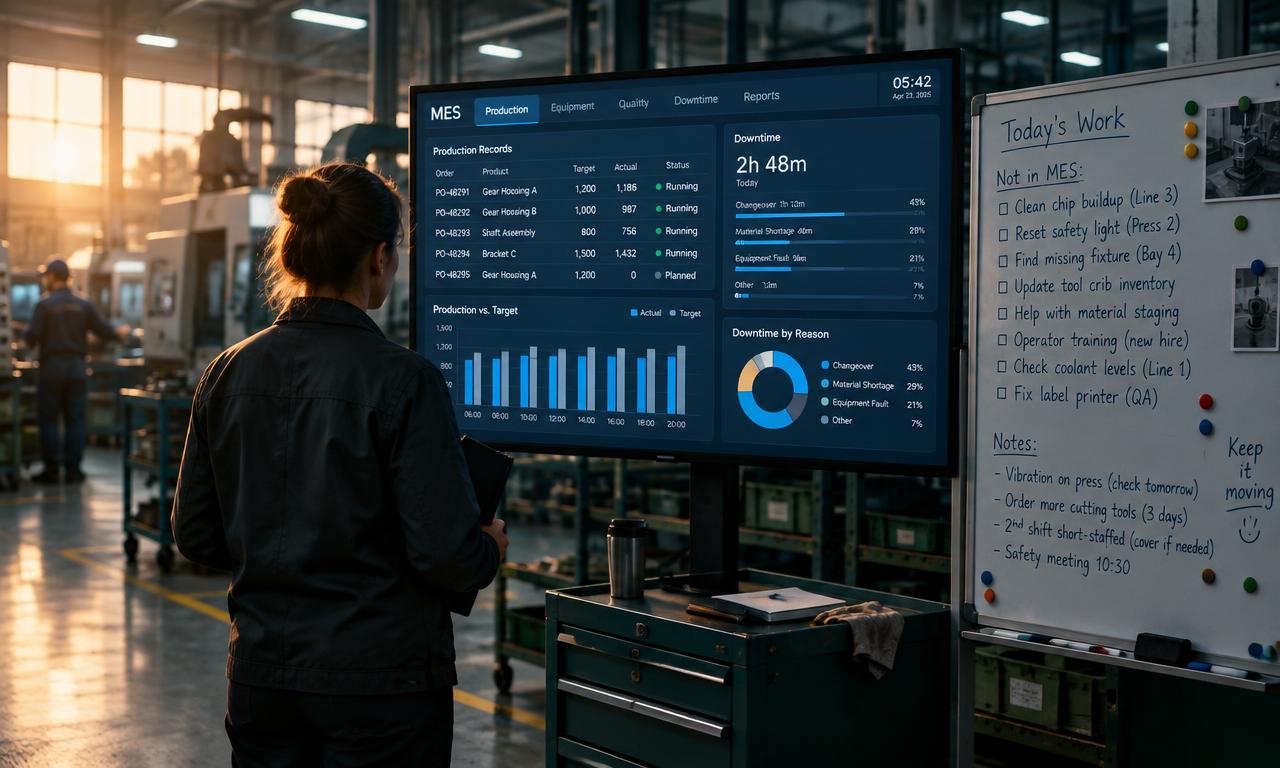
The last two decades of manufacturing technology investment have been extraordinary. We built Systems of Record — ERP, MES, CMMS, historians and industrial platforms — that captured every transaction, every event, every asset history. Then we layered on Systems of Insight — dashboards, analytics platforms, AI models, and visualization tools that helped operations teams understand what was happening across their plants.
Manufacturers today have more operational visibility than at any point in industrial history.
And yet here we are. Unplanned downtime still costs manufacturers tens of billions annually. Workforce decisions still depend on who happens to be on shift when a problem surfaces. Compliance deviations still accumulate quietly while teams are focused on keeping production moving. Work orders still fall through the cracks between the system that detected the problem and the person who needs to fix it.
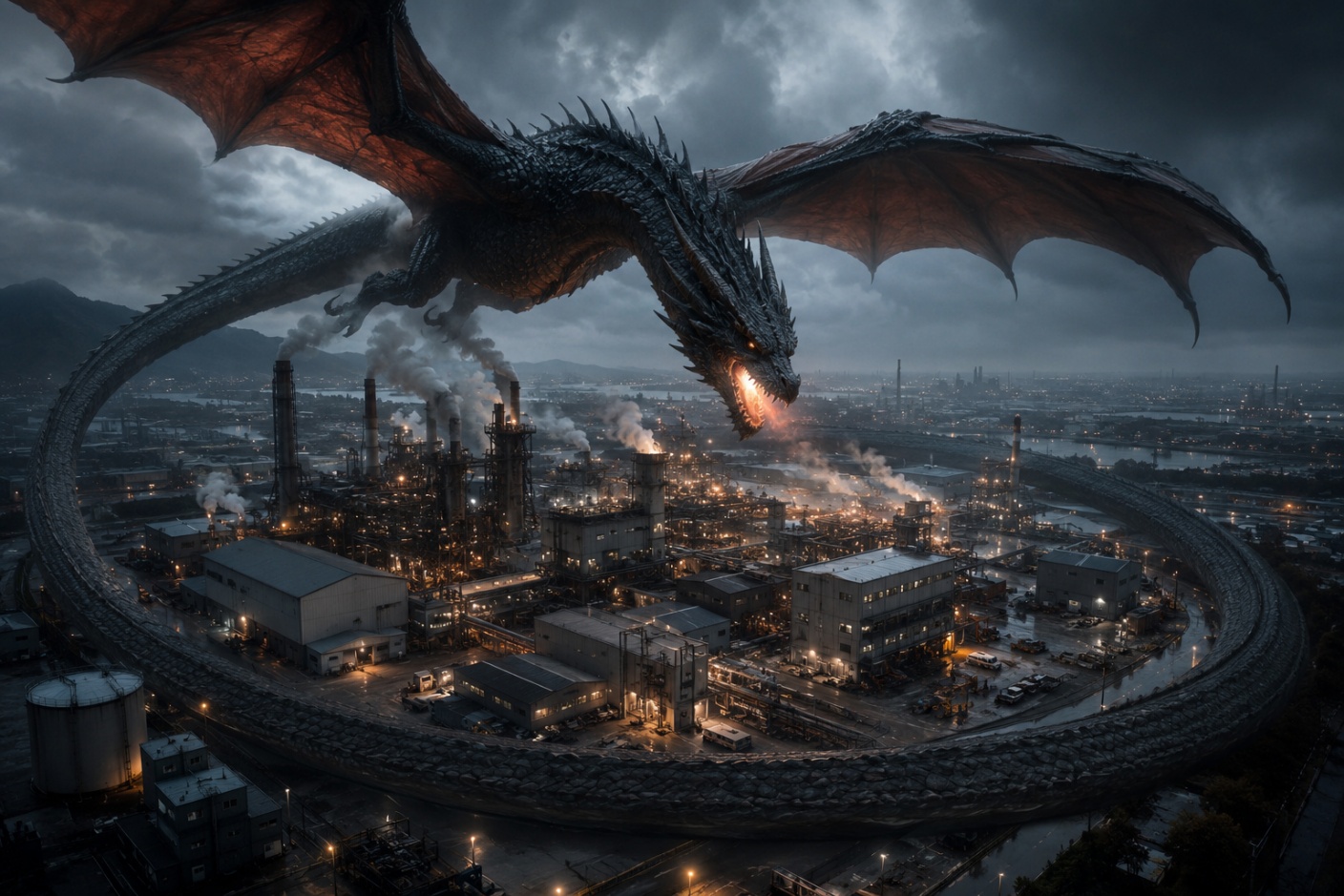
The dragon, it turns out, was never a data problem.
The dragon is an execution problem. A lack of operational execution at speed and scale.
This challenge is not theoretical. Across 218 manufacturing plants and well over 100,000 users worldwide, organizations are already demonstrating that operational performance improves dramatically when execution is managed as a closed-loop system rather than a collection of disconnected tools and processes. The common pattern is clear: the greatest gains are not coming from collecting more data, but from reducing the time between detection, decision, and action.
The Real Threat Manufacturing Leaders Are Facing
In storytelling, there's a concept called the Dragon and the City. The City represents the status quo — valuable, familiar, worth protecting. The Dragon represents the threat circling outside the walls. It doesn't have to be dramatic to be dangerous. Sometimes the most destructive dragons are subtle ones. They cost a little every shift and a lot when they compound over a quarter.
For modern manufacturing, the Dragon is fragmented execution. It's the distance between an anomaly detected and a corrective action taken. Between a workforce gap identified and a staffing decision made. Between a compliance deviation flagged and an escalation triggered. Between insight and action.
The City — your ERP, your MES, your dashboards — is not the problem. Nobody is throwing those away. They're essential. But they were built to capture and display. They were never designed to coordinate.
And the competitive window is closing for manufacturers who continue improving visibility without improving execution.
"The manufacturers gaining ground right now are the ones who chose to attack."
Three Common Responses to the Execution Gap
When manufacturers recognize this execution gap, they tend to respond in one of three ways.
Escape. Hire more analysts. Add more reporting layers. Build a bigger BI team. The hope is that if you can just see the data more clearly, the right actions will follow naturally. The problem is that this approach confuses visibility with execution. You can't hire your way out of a coordination problem.
Defend. Bolt more technology onto the existing stack. Another integration. Another dashboard. Another alert system. This approach strengthens the walls but does little to improve coordination and execution. Often it makes things worse — more systems mean more fragmentation, more places for context to get lost between detection and response.
Attack. Build systems that don't just see the problem but coordinate the response. Systems that close the loop between insight and action automatically, consistently, and at scale.
The manufacturers gaining ground right now are the ones who chose to attack.
They are building operational systems capable of coordinating detection, analysis, decision-making, and execution together in a closed operational loop.
That is the shift from Systems of Insight to Systems of Execution.
This distinction will become increasingly important over the next decade. Most manufacturers have already invested heavily in Systems of Record and Systems of Insight. The emerging competitive battleground is the System of Execution — the operational layer that coordinates people, workflows, data, and AI to ensure that decisions are translated into measurable outcomes.
What an AI-Powered System of Execution Actually Looks Like
The word 'AI' has become so overloaded in manufacturing conversations. Nearly every platform claims AI capabilities.
In many cases, what that means is better prediction models, anomaly detection, or improved visualization. Those capabilities absolutely create value — but they still largely function as Systems of Insight.
The real breakthrough is not another AI model.
It is an orchestration architecture capable of coordinating workflows, systems, people, and operational decisions in real time across the plant.
What's different about the next generation of manufacturing technology isn't the AI itself. It's the architecture.
The shift is from AI as a tool people use to AI as a coordinated operational workforce.
Consider what that looks like in practice:
At 2:00 a.m., a monitoring agent detects abnormal equipment behavior — not simply because a threshold crossed a line on a dashboard, but because it recognized a pattern across three data streams that historically precedes a failure.
An Analytical Agent immediately investigates across maintenance records, MES event logs, operational reports, and institutional knowledge to identify the probable root cause and recommend corrective actions.
A Decision Agent evaluates the operational tradeoff — what does acting now cost versus waiting for the morning shift? What are the downstream production impacts? What's the parts availability?
An Execution Agent automatically coordinates the operational response — creating the work order, routing it to the right technician, triggering the parts request, notifying the shift supervisor, and updating the maintenance log.
A Compliance Agent watches the entire sequence — ensuring the response meets regulatory requirements and internal SOPs, escalating if something falls outside acceptable parameters.
Human oversight remains critical. High-impact decisions still remain under human supervision, with AI coordinating execution and escalation based on operational policies and confidence thresholds. The result is not autonomous manufacturing replacing people.
The result is faster, more coordinated execution with significantly less operational friction. The loop between detection and resolution closes in minutes instead of hours.
In one global manufacturing environment, what previously required multiple systems, email exchanges, shift handovers, and manual follow-up can now be coordinated within a single operational workflow. Issues are detected earlier, actions are assigned automatically, and accountability is maintained throughout the resolution process. The result is not simply faster response times, but more consistent execution across plants, teams, and shifts.
This is what an AI-Powered System of Execution looks like when it is operating effectively.
The Mistake Most Organizations Are About to Make
Here's the uncomfortable truth about where manufacturing AI investment is heading.
Most organizations are about to spend significant budget on AI tools that are, at their core, still Systems of Insight. They will produce better predictions, sharper visualizations, and more sophisticated anomaly detection. They will deliver genuine value. And they will leave the execution gap untouched.
The reason is organizational, not technological. Buying an analytical AI tool feels safe. It extends existing investments. It doesn't require rethinking how work gets done. It produces outputs that look impressive in a board presentation.
Closing the execution gap requires something harder: a willingness to let intelligent systems coordinate action across people, processes, and technology in real time. That's a different kind of trust. It's a different kind of change management. And it delivers a different order of magnitude of impact.
"The manufacturers who understand this distinction early — before it becomes industry convention — are the ones most likely to define the next decade of operational competitiveness."
Where Human Teams Become More Valuable
It is important to clarify something.
An AI Workforce does not replace plant managers, operators, maintenance teams, or operational leadership. It does not replace human judgment, accountability, creativity, or experience.
What it does is free those people to do the work that actually requires them.
Right now, a significant portion of your operations team's cognitive capacity is consumed by coordination overhead — tracking down information, routing decisions to the right people, following up on work orders, checking compliance status. These are not the tasks your best people were hired to do. They are the friction that accumulates between your strategy and your execution.
An AI-Powered System of Execution absorbs much of this operational coordination overhead so human teams can focus on the decisions, exceptions, innovation, and continuous improvement initiatives that actually require human expertise.
The manufacturers that win over the next decade will not necessarily be the one with the most sensors, or the most sophisticated dashboard. They will be the one whose people spend their time on decisions that matter — because every other decision is being handled intelligently, automatically, and consistently, around the clock.
The Question Worth Asking
Before making your next manufacturing technology investment, ask a simple question:
Does this improve visibility or does it improve execution?
Does it reduce the time between operational awareness and operational response? Does it help our teams coordinate decisions faster, more consistently, and at scale?
Because the next generation of manufacturing leaders will not compete on visibility alone. They will compete on how effectively they operationalize intelligence across the enterprise.
That is the difference between observing the Dragon and slaying it.
The manufacturers that lead the next decade will not be defined by the amount of data they collect or the sophistication of their dashboards. They will be defined by how effectively they operationalize intelligence and execute decisions at scale. The winners will build Systems of Execution that continuously connect detection, decision-making, and action across their operations. When that happens, manufacturing intelligence stops being a reporting capability and becomes a competitive advantage.
→ See how an AI-Powered System of Execution performs on your line