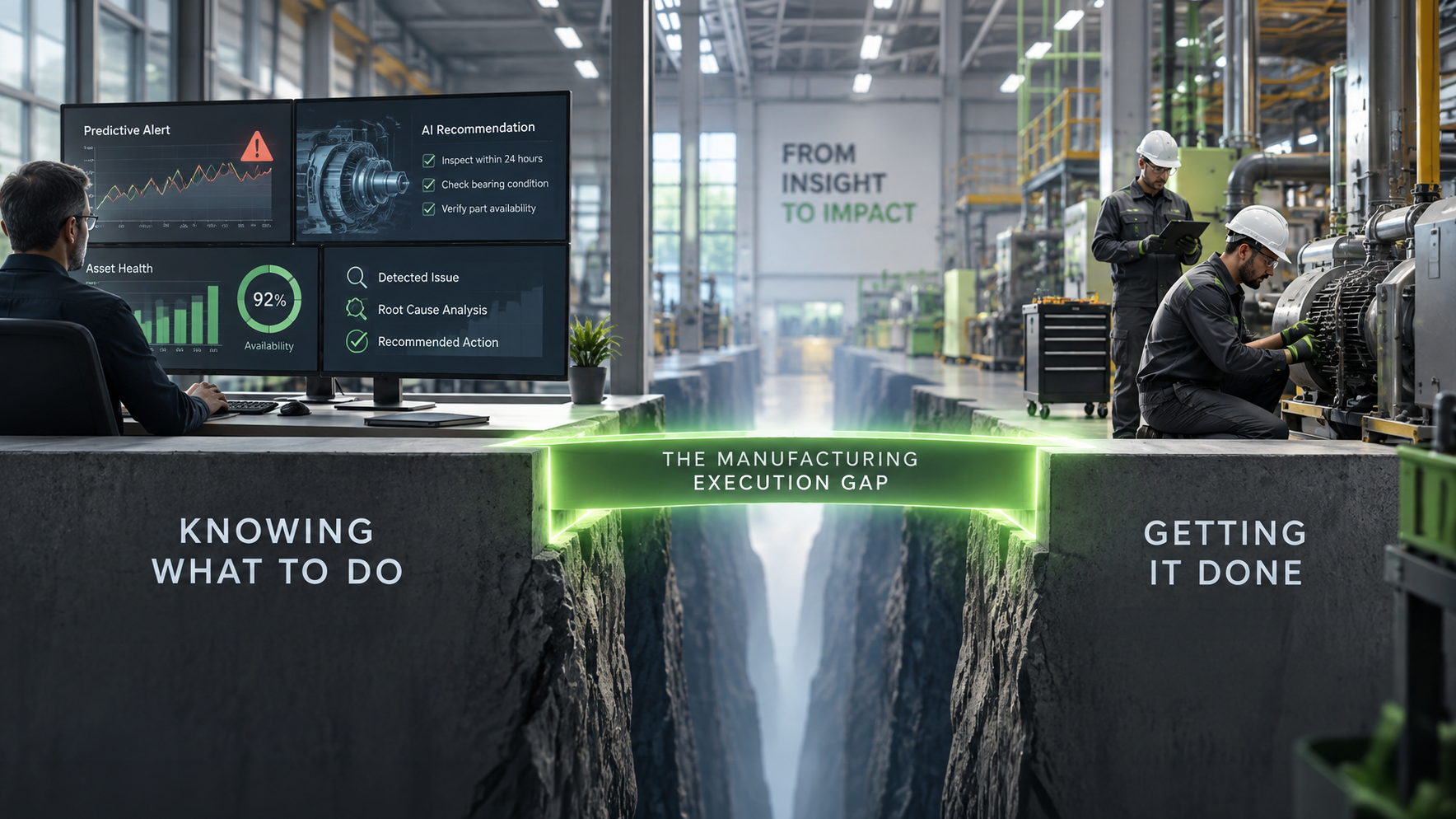

Predictive maintenance tells you the bearing will fail in 9 hours. Prescriptive maintenance tells you which technician to send, which spare to pull, when to schedule the intervention around the run plan, and then opens the work order in your CMMS before the huddle ends. Predictive is a forecast. Prescriptive is a decision that gets executed. On a plant floor, that difference is measured in unplanned downtime hours, technician overtime, and the recurrence rate on the same asset next quarter. See what prescriptive maintenance would lift on your line →
It's 6:55 a.m. at a food and beverage plant in the Midwest. The overnight anomaly detector flagged rising vibration on Filler #3 at 2:14 a.m. The maintenance planner sees the alert at shift start, six hours after it fired. She still has to pull the asset history, check spare availability, find a technician who's certified on that filler, and slot the job into a run plan that already has a changeover at 10:30. By the time the work order lands in the CMMS, it's 8:45 — and Filler #3 is already leaking.
That gap — between the prediction and the executed action — is where most of the money leaks out of a predictive maintenance program. It's also exactly where prescriptive maintenance lives.
What each one actually is
Predictive maintenance uses sensor data (vibration, temperature, current draw, pressure, acoustic) and machine learning to forecast when an asset is likely to fail. It produces an alert, usually with a probability, sometimes with a time window. The output is intelligence: "this asset will likely fail in the next X hours." What happens next is on the humans.
Prescriptive maintenance takes that intelligence and produces a ranked, scheduled, assigned action — with the spare part, the certified technician, the production window, and the CMMS work order already generated. The output is execution: the fix is on the schedule before anyone finishes their coffee.
This is the difference between Manufacturing Intelligence and Operational Execution — and it's the reason most predictive maintenance ROI stalls at the pilot. The model works. The work still doesn't get done fast enough.
Why the gap matters (and why F&B, pharma, and industrials feel it hardest)
- Predictive alone leaves the coordination cost intact. Planners still triage manually. Spares still get looked up manually. Techs still get paged manually. The failure prediction lands in an inbox, not a workflow.
- Alert fatigue turns real signals into noise. When every model output looks the same in Outlook, the fifth true positive gets ignored with the fifty false positives.
- Recurring failures never learn from the last fix. The tribal knowledge of "we tried this three months ago and it didn't hold" lives in one tech's head, not the system.
- Compliance and audit trails stay manual. Pharma and food producers still have to reconstruct why an intervention happened from PDFs, emails, and CMMS free-text fields.
What breaks in a predictive-only stack
- The alert-to-action lag stays measured in hours or shifts, not minutes. The model is fast. The workflow around it isn't.
- Spare parts get pulled reactively. Prescriptive systems trigger the parts reservation the moment the prediction crosses threshold. Predictive-only stacks find out there's no bearing on-site when the technician walks to the crib.
- Scheduling collides with the run plan. Predictive doesn't know Line 4 has a high-margin SKU at 2 p.m. Prescriptive does, and slots the intervention into the changeover window.
- Every fix is a one-off. Without a system that captures the accepted action, the technician's notes, and the outcome, next quarter's identical failure gets re-diagnosed from scratch.
What changes when the execution layer sits on top of the prediction
Prescriptive maintenance isn't a bigger model. It's a system that closes the loop from Factory Data → Manufacturing Intelligence → Operational Execution → Operational Excellence. The prediction is one input. The other inputs are the run plan, the spare parts inventory, the technician skills matrix, the asset history, the safety procedures, and the last five interventions on the same asset.
That's the job of an AI Workforce — specialized agents coordinating across those data sources so the maintenance planner doesn't have to. In Decisyon's AI-Powered System of Execution, the Fix Finder agent surfaces "we solved this before, here's what worked." The Compliance Manager agent confirms the intervention meets the CAPA and audit requirements. The scheduling agent slots the job around the run plan. The prediction becomes a decision, and the decision becomes a scheduled, tracked, closed work order.
Real-world case study: what this looks like in practice
A global electronics and semiconductor manufacturer moved from monitoring dashboards to prescriptive maintenance on Decisyon LOOP. The AI model runs on data sampled every 6 seconds, live prediction accuracy averages above 90%, and advance warnings arrive 24 minutes to more than 11 hours before failure. But the number that matters most is what happens after the prediction: virtually all unplanned machine downtime at the pilot plant has been eliminated, because the Next Best Action Recommender turns each alert into a ranked, scheduled work order with a live failure countdown and the underlying model reasoning exposed in-line to the technician.
Every accepted or rejected action feeds back into the model, so the system keeps learning from the plant it runs. That's the Operational Excellence loop closing.
Estimate what closing that gap would be worth on your own assets: ROI Report →. Read the full breakdown: Electronics & Semiconductor Predictive Maintenance case study.
Prescriptive vs predictive maintenance: how the capabilities actually compare
| Capability | Preventive (calendar) | Predictive (alert-only) | Prescriptive (execution) |
|---|---|---|---|
| Trigger | Fixed schedule | Real-time signal + ML forecast | Real-time signal + ranked action |
| Output | Work order regardless of condition | Alert with probability | Assigned, scheduled work order |
| Spare parts | Manual lookup | Manual lookup | Auto-reserved on threshold |
| Technician assignment | Manual | Manual | Auto-matched to skills + shift |
| Production run plan awareness | None | None | Scheduled into changeover window |
| Learning loop | None | Model self-tunes on signal | Model + workflow tune on outcomes |
| Auditable "why we acted" trail | Partial | Alert log only | Full decision + outcome trail |
| Executive metric moved | Compliance % | Downtime forecast | Unplanned downtime hours |
Most plants own column 1 or column 2. Column 3 is where the P&L moves.
What to ignore, and three questions to ask any vendor
Ignore any vendor whose demo ends at the alert screen. Ignore the "AI-powered" label without a work order coming out the other end. Ignore accuracy numbers that aren't paired with mean-time-to-execution.
Three questions that separate prescriptive from repackaged predictive:
- Does the system open the CMMS work order automatically, or does a human still copy-paste from your dashboard?
- When the model recommends an action, can the technician see why — the sensor data, the past interventions on this asset, and the confidence level — in one screen?
- What happens to the recommendation after the fix? Does the system learn from the outcome, or does the next identical failure start from zero?
If any answer is "the customer handles that," you're looking at predictive with a marketing coat of paint.
Where Decisyon fits
Decisyon LOOP is the AI-Powered System of Execution that sits on top of predictive models — yours or ours — and turns the prediction into a scheduled, assigned, tracked action. The AI Workforce (Fix Finder, Compliance Manager, Meeting Insight, and the maintenance-specific agents) coordinates the work that used to sit on planners' desks. The outcome is Operational Excellence measured where the CFO looks: unplanned downtime hours, MTTR, technician overtime, and recurrence rate on the same asset.
Estimate the lift on your own lines: ROI Report →. See how manufacturers are already running this stack: Case studies →.