
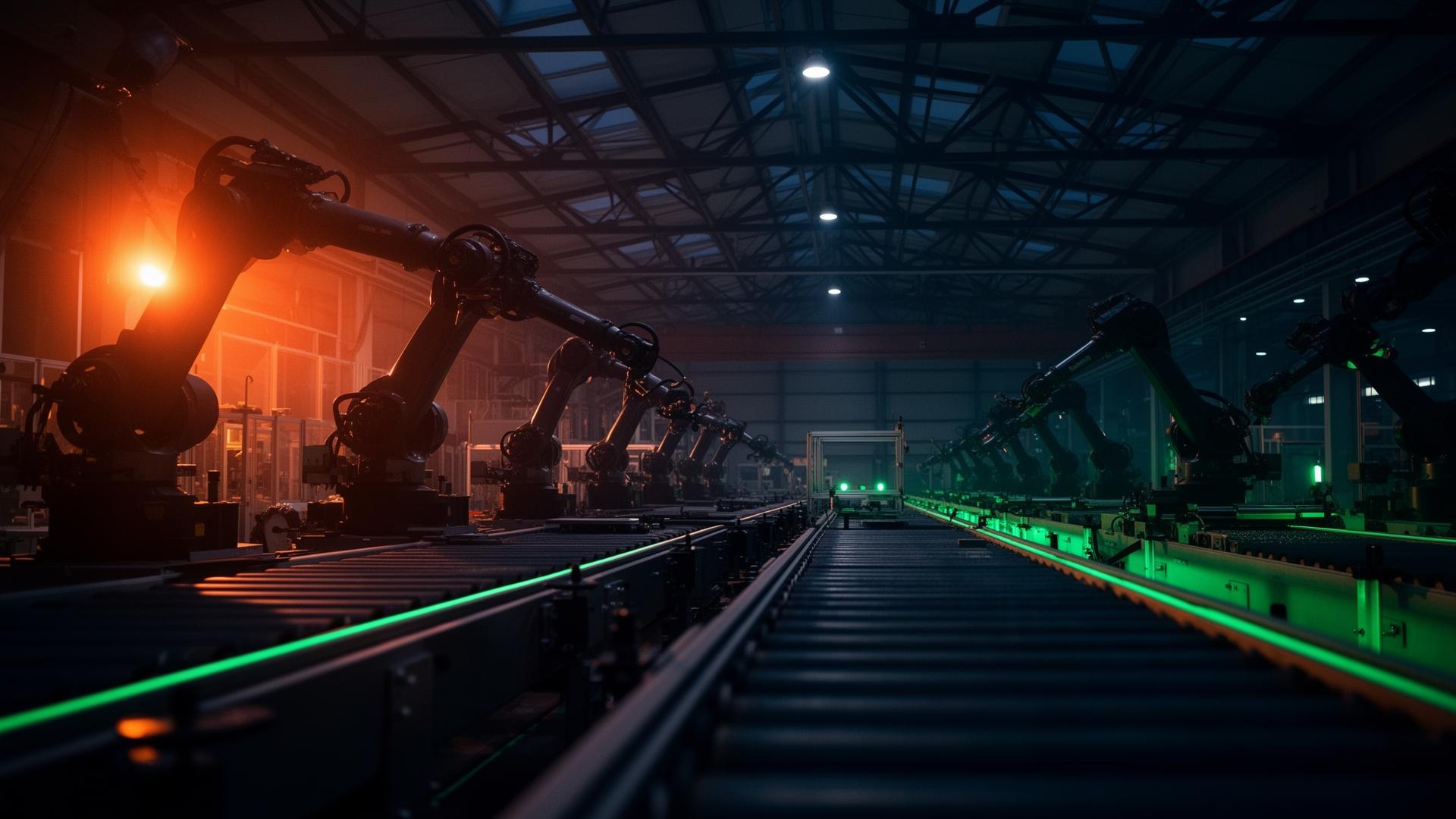
Catch the failure before it catches you.
Every unplanned stop, every wasted spare, every emergency call-out is margin walking out the door. Decisyon's AI agents predict the failure, find the root cause, suggest the fix, create the work order and integrate with the maintenance workflow.

From firefighting to foresight — with the fix already in hand.
Most plants live somewhere between reactive ("it broke, go fix it") and calendar-based ("swap the part whether it needs it or not"). Both burn money. Predictive maintenance software finally sees what's coming. Prescriptive maintenance closes the loop — telling your team exactly what to do, when, and with which parts.
That shift attacks the three silent killers of plant profitability: avoidable downtime, bloated spare-parts inventory, and labor stuck firefighting instead of improving. See what those three are costing your plant.
Five leaks, every single shift.
Unplanned downtime in factories usually traces back to five recurring causes: equipment wear that calendar PMs miss, sensor or alarm noise without context, inconsistent maintenance practice across shifts and sites, late-stage failures the team only sees after the line stops, and spare-parts gaps when a fix is finally identified. Predictive maintenance attacks all five before the line stops — calculate what each hour of downtime costs you.
A line goes down mid-shift and the whole day's plan goes with it.
You're swapping parts that still had life left — or finding the damage after it's already done.
An alarm screams. Nobody knows what's actually wrong. Hours disappear into diagnosis.
Every site runs maintenance its own way. Best practices never travel.
Maintenance spend rises, asset life shortens, and the CFO starts asking hard questions.
Four steps. No rip-and-replace. Your sensors stay where they are.
- 1. Connect what you already have. The Decisyon Smart Gateway plugs into the vibration, heat, pressure, and acoustic sensors already on your line — no equipment overhaul.
- 2. Learn what "normal" looks like. AI agents establish a healthy baseline for each asset from its own history. Every machine becomes its own benchmark.
- 3. Catch the anomaly humans miss. Predictive agents flag the early deviation a tech walking the floor — or a fixed-threshold alarm — would never see.
- 4. Prescribe and dispatch. The risk is named, a work order is opened in your CMMS or ERP, and the right technician shows up with the right parts and the diagnostic data already in hand.
One tells you a failure is coming. The other tells you what to do about it.
Predictive maintenance reads live signal from your assets and warns you that a failure is developing. Prescriptive maintenance goes one step further: it names the fault, the part, the technician and the window, then opens the work order in the system your team already uses. Most plants buy the first and still lose hours to triage, because the alert arrives without an answer attached.
| On the floor | Predictive maintenance | Prescriptive maintenance |
|---|---|---|
| What you get | A warning that an asset is degrading | The fault, the cause, the fix and the parts |
| Who diagnoses it | A planner or engineer, after the alert | The agent, before anyone is paged |
| What happens next | Someone decides whether to act | A work order lands in the CMMS with the technician assigned |
| Time from signal to action | Hours to days | Minutes |
| What it needs from you | Sensor data and a model | Sensor data, repair history and the CMMS you already run |
Decisyon runs both on the same connection to your existing controls. Fix Finder reads corrective-action history across your plants and routes the proven repair to the technician at the asset; Deep Find pulls the manual page and the past work order behind that fault. Size the downtime you would recover before you scope a deployment.
From "we think something's wrong" to "here's the asset, the fault, the fix, and the tech on the way."
AI agents amplify your existing sensor data with high-fidelity synthetic signals — production-grade accuracy in weeks, not the years a traditional model would need.
Prescriptive agents classify the exact fault, the severity, and the asset — so the first person on the scene already knows what they're walking into.
Technicians see why the model made the call. Trust builds. Adoption sticks. Audits get easier.
A built-in MLOps feedback loop learns from your technicians' fixes — the agents improve as your team teaches them.
An LLM-powered agent writes the work order with the right parts, the right safety notes, and the right tech — delivered the moment the risk is real.
Maintenance stops being a cost center. It starts protecting throughput.
- · Months of model training and custom integrations before anything runs
- · Alerts and dashboards — diagnosis is still on your team
- · Black-box scores no one trusts
- · Static models that drift as machines age
- · Rigid architectures that can't keep up with your plant
- · Pre-trained agents, connected to your existing controls. Live in weeks.
- · Prescriptive work orders with parts, steps, and the right technician attached
- · Transparent model reasoning and confidence — visible to every tech
- · Self-improving MLOps loop that learns from every fix
- · Built on Decisyon App Composer — adapts to your line, not the other way around
See Predictive Maintenance running on one of your assets.
Real sensors. Real failure signatures. Real work orders. Inside an hour you'll see what the agents catch, what they prescribe, and what it would have cost you to find out the old way.
One plant. One use case. Real data.
Clear success criteria. Walk away on day 14 if it doesn't move the number.